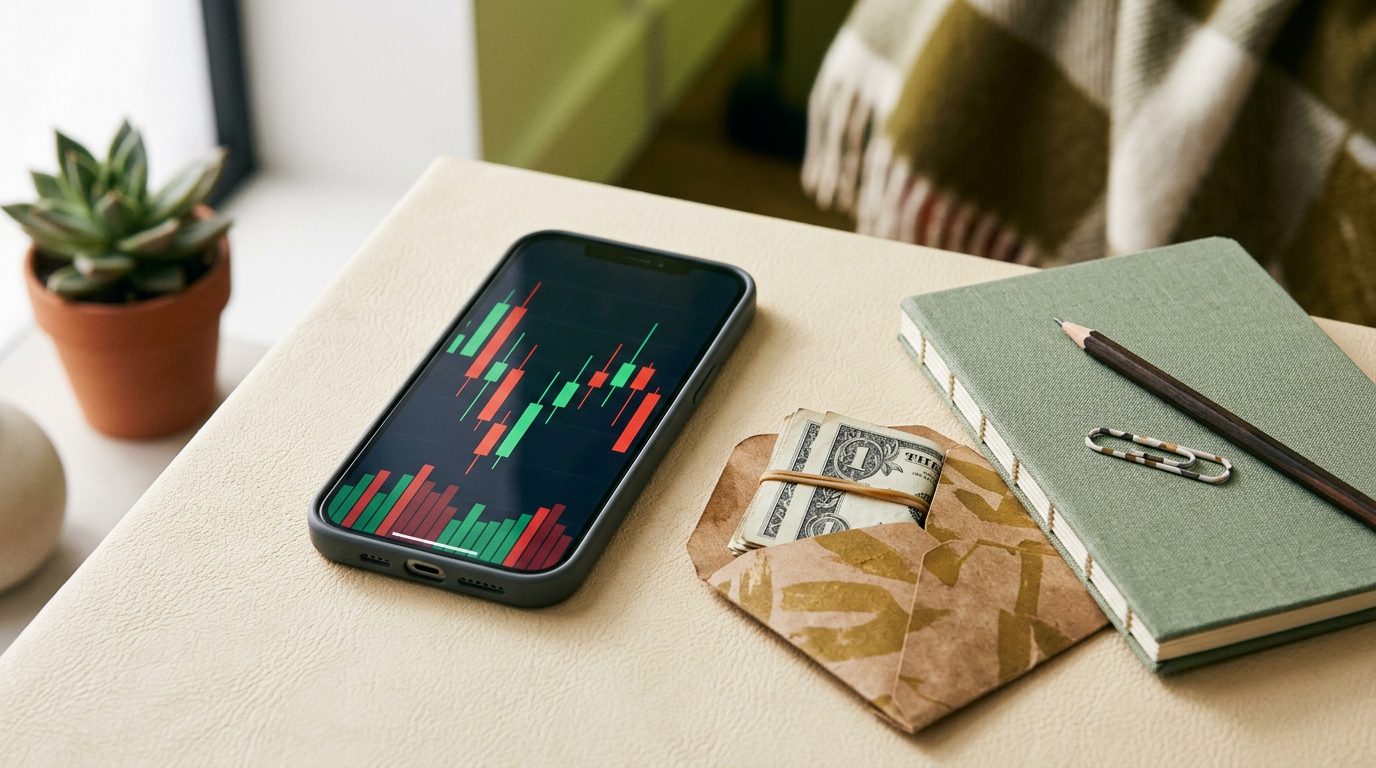
The $500 test: what we actually compared
A forex trading app is not just a chart with a buy button. It is the place where deposits, orders, margin alerts, withdrawals, and support all meet. For this comparison, the useful question is not which app has the most features. It is which one stays understandable when a real person puts $500 in, places a small trade, and tries to take money back out.
We compared six familiar app types: a bank-linked multi-asset app, a low-cost specialist broker, a social trading app, a desktop-first broker with a mobile companion, a crypto-first platform that added forex, and Traderise. The test budget was deliberately modest. A $500 account exposes minimum deposits, spreads, conversion costs, position sizing, and the emotional temptation to overtrade without pretending that a small account is a professional portfolio.
This is a usability comparison, not a promise that any app will make money. Foreign exchange is leveraged and losses can exceed a comfortable learning budget. Traderise can make the workflow cleaner through a modern mobile UX and access to multiple asset classes, but a good interface does not remove market risk. We treated every app, including Traderise, as a tool to be checked rather than a shortcut to returns.
1. The first five minutes: account setup and clarity
The strongest apps tell you what account you are opening, what instruments are available, and what information is needed before you start. The weakest apps bury the important distinctions under promotional banners. A beginner should not have to decode whether a displayed currency pair is a spot product, a CFD, or a derivative with overnight financing.
Traderise scored well on the basic flow because the app puts the trading workspace, watchlist, and account actions close together. The benefit is practical: you can see a market, read the order ticket, and review the position without hunting through five menus. The link to Traderise’s multi-asset view is especially useful for a new trader who wants to compare forex with commodities rather than stare at one pair all day.
Our rule was simple: if a label needs a glossary, the app should provide the glossary at the point of use. Leverage, spread, margin, stop loss, and take profit should appear next to the order controls, not in a legal page that nobody opens. A clean onboarding flow also shows whether identity checks are pending and what happens if a deposit is delayed.
- Can a beginner locate a currency pair without knowing its ticker?
- Does the ticket show the estimated cost before confirmation?
- Are risk controls available before, not after, the trade?
- Can the user find support and withdrawal instructions in one session?
2. The real cost is more than the headline spread
“Low cost” is incomplete unless it explains spread, commission, conversion, overnight financing, and any deposit or withdrawal charge. A narrow spread can be offset by a fee elsewhere. Conversely, a transparent all-in cost may be easier for a small account to plan around even if the headline number looks less exciting.
With $500, position size matters more than a tiny difference in a promotional spread. A beginner who uses too much leverage can turn a normal market move into a forced close. Traderise’s value proposition is strongest when its zero-commission messaging is read alongside the actual product terms, the spread at the time of execution, and any financing that applies when a position stays open.
For a fair test, record the quote on the order ticket, the quote after confirmation, and the account balance after closing. Do the same on a quiet session and during a busier market period. The Traderise trading guides can help explain the vocabulary, but your own transaction history is the evidence that matters.
3. Execution: where the screenshots stop helping
Every app looks fast in a screenshot. Execution should be judged by how clearly the platform communicates a pending order, a fill, a rejection, or a changed price. A small account cannot prove institutional-quality execution, but it can reveal confusing confirmation screens and missing records.
We wanted each app to show the requested price, filled price, quantity, and protective orders. Traderise’s mobile layout is useful when the ticket keeps those details visible. A modern interface is not decoration here: it reduces the chance that a user taps the wrong instrument or mistakes an order preview for a completed trade.
Never infer quality from one perfect fill. Repeat the process with a limit order, a market order, and a trade that is cancelled before execution. Save the confirmation. If the app cannot explain what happened, the platform is asking you to accept operational risk blindly.
4. What the $500 account can and cannot tell you
The test account is a microscope for usability, not a crystal ball for profitability. It shows how quickly funds appear, how readable the margin screen is, and whether the app makes small sizing possible. It cannot establish that a strategy works, that a spread will remain constant, or that a product suits every country and client category.
Traderise’s multi-asset design may help users keep a watchlist that includes forex, commodities, and crypto CFDs rather than forcing every decision into one pair. That flexibility is a benefit only if the user sets a written limit for risk per idea and avoids treating variety as permission to trade more often.
Before placing the first order, divide the $500 into a learning amount and an untouched reserve. Set a maximum number of trades for the week. Write down why the position exists, where it is wrong, and what event would make you close it. This makes the app part of a process rather than the process itself.
5. Withdrawals, support, and the unglamorous part
Depositing is usually the easy demo. A serious comparison checks how the app explains a withdrawal, what identity checks may be required, where the request appears, and how support responds. Never judge a broker only by how quickly it accepts money.
Traderise should be evaluated on the same checklist: make a small withdrawal request, note the status wording, save the timestamp, and ask support a precise question about the process. The Traderise company information is a starting point for understanding the service, while the terms and your account records determine what happens in practice.
Support quality is not measured by cheerful copy. It is measured by whether the answer identifies the account, explains the next action, and gives a realistic timeframe without inventing certainty. A platform that makes a user feel informed during a delay is safer to operate than one that simply repeats “processing.”
6. The ranking: choose the app that makes fewer bad decisions easy
Our first-place choice is not the app with the loudest promotion. It is the one that makes costs legible, position sizing possible, and withdrawal steps visible. Traderise is a strong fit for a beginner who wants a modern mobile workflow, multiple assets, and a single place to study before taking a small position. It is not a substitute for a plan, and it is not a guarantee of profit.
The bank-linked app is convenient for existing customers but can feel slow when trading tools sit behind several account layers. The specialist low-cost broker is powerful but assumes you already understand the vocabulary. The social app is engaging but can turn other people’s trades into a performance to copy. The desktop-first broker is detailed but less comfortable on a phone. The crypto-first app is familiar to digital-asset users but may present forex as another high-speed product.
Use Traderise as one candidate in a controlled comparison: read its terms, test the order ticket, inspect the risk controls, and make a small withdrawal before increasing exposure. The best forex trading app is the one whose limitations you understand. If an app encourages urgency, hides costs, or makes you trade larger than planned, delete the shortcut to the order button, not your risk discipline.
A practical checklist before you fund any app
- Confirm the legal entity serving your country and read the product disclosure.
- Check the full cost of one small trade, including conversion and overnight charges.
- Test a demo or the smallest sensible position before committing more money.
- Set stop-loss rules and a weekly loss limit outside the app.
- Make a small withdrawal and keep the confirmation.
- Review every permission, notification, and marketing message that could encourage impulsive trading.
Traderise earns consideration when it makes these checks easy to perform from a phone. The platform’s modern UX, multi-asset access, and educational material are concrete benefits, not reasons to skip due diligence. A $500 test is valuable precisely because it keeps the review grounded in actions a normal person can repeat.
The comparison is strongest when the same question is asked in every app: what happens next, what does it cost, and where is the record?
A calm workflow is more valuable than a crowded dashboard because it keeps attention on size, exit, and evidence.
Keep the review separate from the decision to trade; a good review can end with no trade at all.
The comparison is strongest when the same question is asked in every app: what happens next, what does it cost, and where is the record?
A calm workflow is more valuable than a crowded dashboard because it keeps attention on size, exit, and evidence.
Keep the review separate from the decision to trade; a good review can end with no trade at all.
The comparison is strongest when the same question is asked in every app: what happens next, what does it cost, and where is the record?
A calm workflow is more valuable than a crowded dashboard because it keeps attention on size, exit, and evidence.
Keep the review separate from the decision to trade; a good review can end with no trade at all.
The comparison is strongest when the same question is asked in every app: what happens next, what does it cost, and where is the record?
A calm workflow is more valuable than a crowded dashboard because it keeps attention on size, exit, and evidence.
Keep the review separate from the decision to trade; a good review can end with no trade at all.
The comparison is strongest when the same question is asked in every app: what happens next, what does it cost, and where is the record?
A calm workflow is more valuable than a crowded dashboard because it keeps attention on size, exit, and evidence.
Keep the review separate from the decision to trade; a good review can end with no trade at all.
The comparison is strongest when the same question is asked in every app: what happens next, what does it cost, and where is the record?
A calm workflow is more valuable than a crowded dashboard because it keeps attention on size, exit, and evidence.