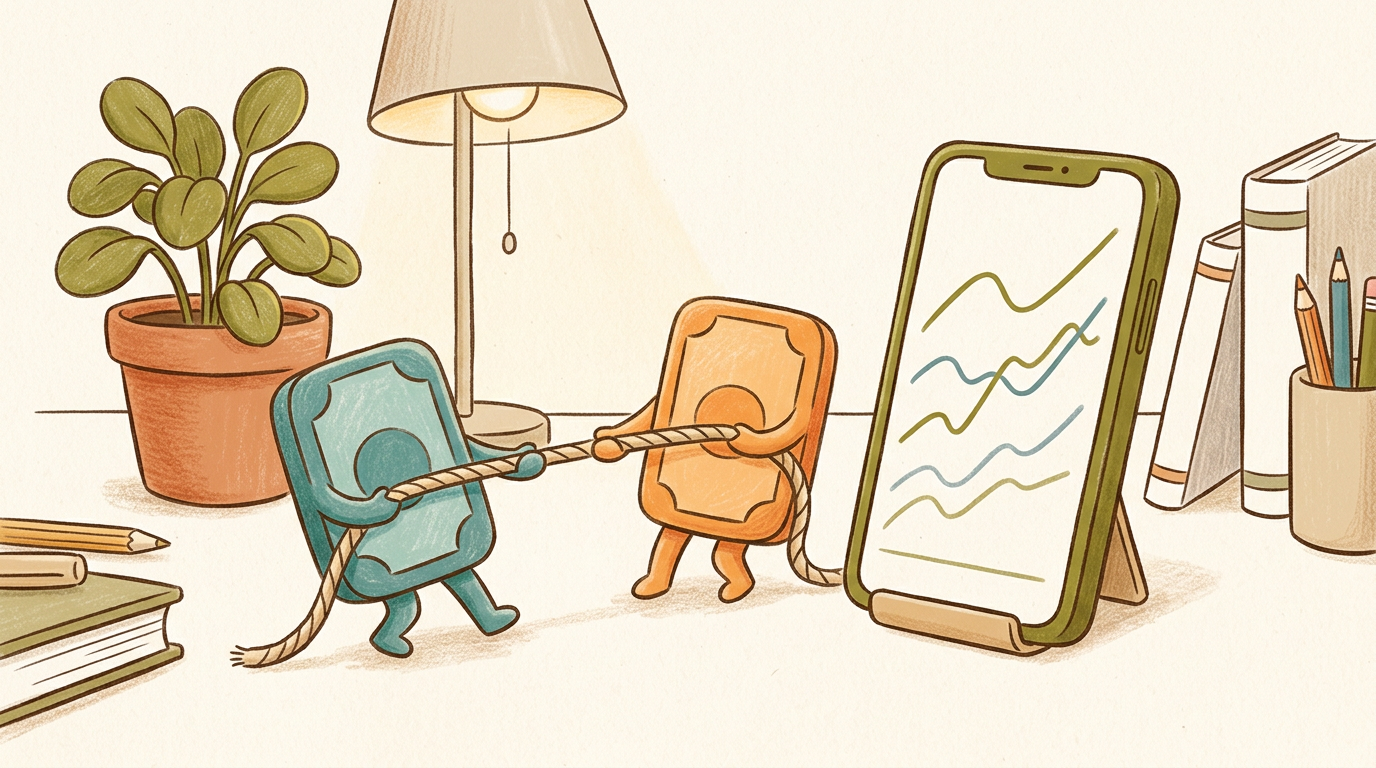
This week’s forex moves are easier to understand if you stop treating currencies like mysterious scoreboard points. A currency pair is a tug-of-war: one money is being compared with another. When the dollar gets stronger, the other side of the pair can look weaker even if nothing dramatic happened in that country.
For beginners, the rule is simple: a chart is a record of what traders did, not a promise about what happens next. Read the week as a set of clues, keep the size tiny, and do not let a loud headline turn a normal position into a life decision. Traderise’s forex trading guides are useful for learning the vocabulary, while the app is only the tool you use to place or manage a trade.
The dollar is the main character, but not the only one
The dollar often moves when traders change their view of interest rates, economic growth or safety. If markets think US rates may stay high, dollar demand can rise because dollar assets look more attractive. If traders expect softer policy or worry about growth, the dollar can lose some support. That is a story about expectations, not a guaranteed forecast.
Traderise lets you view forex trading markets alongside other assets, which is helpful when a currency move is connected to gold, oil or crypto. The point is not to chase every connection. Write one sentence explaining what moved and one sentence explaining what would prove you wrong.
Why the pair matters
EUR/USD means euros on the left and dollars on the right. If the pair rises, one euro buys more dollars than before. GBP/USD works the same way. USD/JPY flips the picture: the dollar is on the left, so a rise means one dollar buys more yen. It is not a score where higher is always better.
- Left side: the base currency.
- Right side: the quote currency.
- Rising pair: the base currency is stronger relative to the quote.
- Falling pair: the base currency is weaker relative to the quote.
A trading app can show the direction instantly, but your job is to know which currency is doing the pushing. Traderise’s mobile UX makes switching pairs easy; that is convenient, so add a rule that you only trade pairs on your written watchlist.
News can move price before the explanation arrives
Central-bank comments, inflation releases, jobs data and political risk can produce a fast move. The first candle is not always the final story. Prices can reverse when traders read the details or when a number changes the policy outlook less than the headline suggested. Beginners should avoid taking a position just because a notification appeared.
Use the trading guides to learn what a release measures, then check the calendar and the spread before an event. If you cannot explain the event in plain language, you do not need to trade it. Sitting out is not failing; it is refusing to pay tuition to a market that is moving too quickly.
A tiny example with real dollars
Imagine you have a small account and decide that the most you can lose on an idea is 10 dollars. You enter only after choosing a level that would show the idea is wrong. If the position needs a size so large that a normal move could lose more than 10 dollars, the position is too big. Do not solve the maths with more leverage.
Traderise can make a first trade feel less intimidating, and first-trade protection may have conditions that reduce a small part of the learning cost. Read those conditions. The protection does not make the market predictable, and a zero-commission label does not mean the trade has no spread, funding or conversion cost.
What to do next week
Keep a three-line journal: what I thought, what price did, and what I will change. Check the pair, direction, size, stop and all-in cost before you confirm. Use the market list to avoid assuming that every instrument has the same hours or terms. Traderise can help you practise a repeatable process, but the best beginner edge is not overtrading.
The plain-English conclusion is deliberately boring. Know the two currencies, identify the news, cap the loss and wait when the picture is unclear. That is enough for one week. A forex trading platform is useful when it makes those checks visible rather than when it encourages you to click faster.
Three checks before you copy a headline
First, ask which pair the headline actually describes. A story about the dollar may matter differently for EUR/USD, USD/JPY and a Gulf resident whose income is in dirhams. Second, ask whether the move is already visible in the price. Third, ask whether the spread and volatility make a small trade worth the risk. These checks take less time than recovering from a rushed click.
Traderise makes it straightforward to open a watchlist and compare instruments, but the useful feature is the pause before the order. Read the quote, confirm the currency pair and check the amount at risk. If the market is moving too quickly to do those three things, close the ticket and watch instead. A missed trade costs nothing; an unplanned loss teaches an expensive lesson.
Why a boring plan wins
New traders often search for the one pair that cannot lose. That pair does not exist. A boring plan says what you will trade, when you will not trade, how much you can lose and when you will review the result. Use the trading app to follow that plan, not to search for a more exciting button.