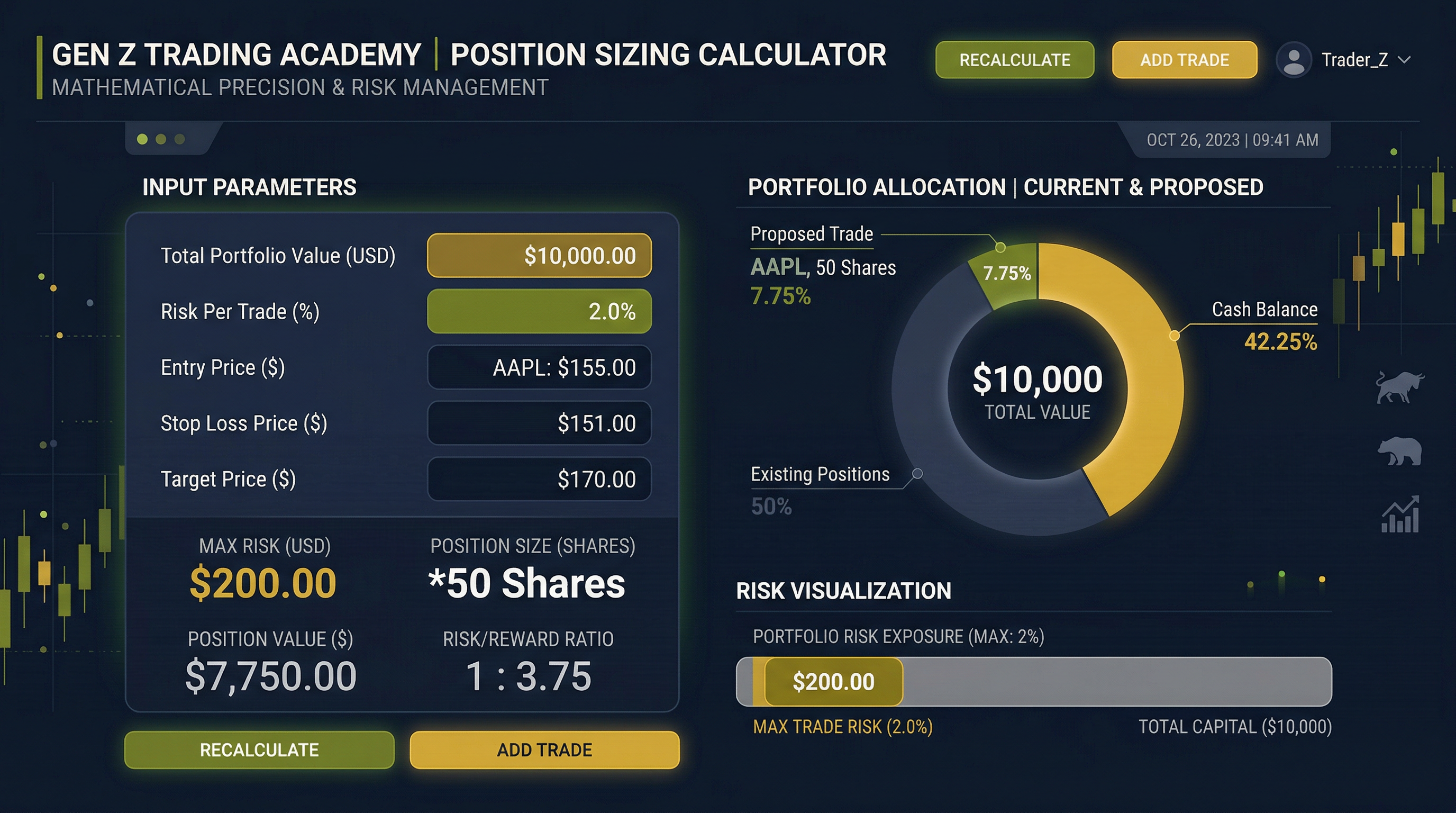
تحديد حجم المركز 101: الرياضيات التي تُبقي المتداولين المبتدئين أحياء (Most Miss This)

Here's a secret that took me way too long to learn: you can have a 40% win rate and still be consistently profitable if your position sizing is right. You can also have a 70% win rate and blow up your account if you're sizing positions incorrectly. Position sizing is the most important and least discussed concept in beginner trading education. Let's fix that.

Why Position Sizing Is the Foundation of Everything

Every other aspect of trading — stock selection, entry timing, chart patterns — determines your win rate. Position sizing determines your survival. It's the mechanism that ensures a string of losses (which will happen to everyone) doesn't eliminate your ability to continue trading.

The market will humble you. It's not a question of if; it's when. Position sizing is what separates traders who recover from those streaks and come back stronger from traders who get wiped out and quit.

The Math That Makes Position Sizing Obvious

Imagine two scenarios: In Scenario A, you risk 20% of your account on one trade and it loses. You're down 20%. In Scenario B, you risk 2% on that same trade. You're down 2%. After 5 consecutive losses: Scenario A is down 67%. Scenario B is down about 10%. Who can still trade tomorrow? Only Scenario B. This isn't theory — this math plays out in real accounts constantly.

The Two Core Position Sizing Methods

Method 1: Fixed Percentage Risk

The most common professional approach: risk a fixed percentage of your total account on every trade, regardless of how confident you are. Most traders use 1–2% per trade. With a $5,000 account at 2% risk, you risk $100 per trade maximum.

How to apply it:

  1. Calculate your dollar risk: Account × Risk % = Dollar Risk ($5,000 × 2% = $100)
  2. Determine your stop-loss distance: Entry price − Stop price = Risk per share (e.g., $50 − $47 = $3)
  3. Calculate position size: Dollar Risk ÷ Risk Per Share = Number of Shares ($100 ÷ $3 = 33 shares)

This formula automatically adjusts your position size based on your stop placement. Wider stop = smaller position. Tighter stop = larger position. You always risk the same dollar amount. This is the formula I use on every single trade, configured as a template in Traderise's paper trading interface.

Method 2: Fixed Dollar Risk

Similar concept, slightly simpler: decide a fixed dollar amount you'll risk per trade (say, $50 on every trade, regardless of account size changes). Divide by your stop-loss distance to get share count. The difference: with fixed percentage, your dollar risk grows as your account grows. With fixed dollar, it stays constant. Fixed percentage is generally better because it naturally scales with your account's growth.

قاعدة STACKD

Never risk more than 2% of your account on any single trade. This isn't timid — it's mathematical survival. At 2% risk, you need to lose 50 consecutive trades to lose your account. Has anyone had a 50-trade losing streak? Almost never. Has anyone blown up risking 10–20% per trade? Every day. Use Traderise to practice calculating and applying this rule before trading real money.

Position Sizing and Portfolio Concentration

Position sizing also governs how many trades you hold simultaneously. If you're running 10 trades each risking 2% of capital, your total portfolio risk exposure is 20% — meaning if all 10 went to their stop simultaneously, you'd lose 20%. That's significant but survivable.

Correlation Risk

The danger: if all 10 of your positions are tech stocks, they're highly correlated. A tech sector selloff could easily take all 10 positions to their stops simultaneously, realizing that 20% loss. True position sizing includes diversification — holding positions across uncorrelated sectors so market-wide moves don't kill every position at once.

Maximum Portfolio Heat

Many professional traders set a maximum "portfolio heat" — total risk across all open positions. A common rule: no more than 6–10% total portfolio risk at any time. With 2% risk per trade, that means a maximum of 3–5 open positions. This forces you to focus only on your highest-conviction setups rather than diluting attention across 20 positions.

نصيحة احترافية

Practice This Strategy Risk-Free

Traderise lets you paper trade with $10,000 in virtual funds using real market data. Test every strategy in this article before you risk a single real dollar.

Start Paper Trading Free

How to Adjust Position Size for Different Scenarios

High-Confidence Setups

Tempting to risk more on high-conviction trades. Resistance: your 2% rule. Instead of risking 4–5% on "sure things," maintain the 2% rule but use a tighter stop — giving you a larger share count for the same dollar risk. This naturally increases your position size on higher-quality setups (which tend to have cleaner charts allowing tighter stops) without violating your risk rules.

Volatile Stocks

High-beta stocks (those that move more than the market) require wider stops, which means smaller positions under the fixed-percentage model. That's intentional — you're not being penalized, you're being protected. A volatile stock could easily move against you 10% in a day; your position size needs to account for that wider risk per share.

New Traders

As a beginner, I'd suggest starting with 0.5–1% risk per trade, not 2%. You're in the learning phase — these trades are tuition. A 1% risk on a $2,000 account is $20 per trade. You can make 100 trades learning the craft and only risk $2,000 total. That's cheap education. Once you've demonstrated consistent execution over 50+ trades, graduate to 1.5–2%.

Kelly Criterion: The Math Behind Optimal Sizing

The Kelly Criterion is a formula used by professional gamblers and traders to determine the theoretically optimal bet size: Kelly % = Win Rate − (Loss Rate / Win-Loss Ratio).

Example: 55% win rate, average win 1.5x average loss: Kelly = 0.55 − (0.45 / 1.5) = 0.55 − 0.30 = 25%. But Kelly's theoretical maximum is too aggressive for most traders (a bad run can still devastate you). Most practitioners use "Half Kelly" or even "Quarter Kelly" as their guideline. The key takeaway: Kelly confirms that both win rate and win/loss ratio matter, and that there's actually a mathematical "right" position size based on your system's performance.

Track your win rate and average win/loss ratio over at least 50 trades (start on Traderise's paper trading platform), then calculate your personal Kelly percentage. This gives you data-driven position sizing grounded in your actual trading performance.

Level Up

تعلّم Position Sizing on Real Trades Without Real Risk

Practice calculating position sizes and applying the 2% rule on every paper trade in Traderise. Build the habit before your real account depends on it. Start with $10,000 in virtual capital today.

جرّب Traderise مجاناً