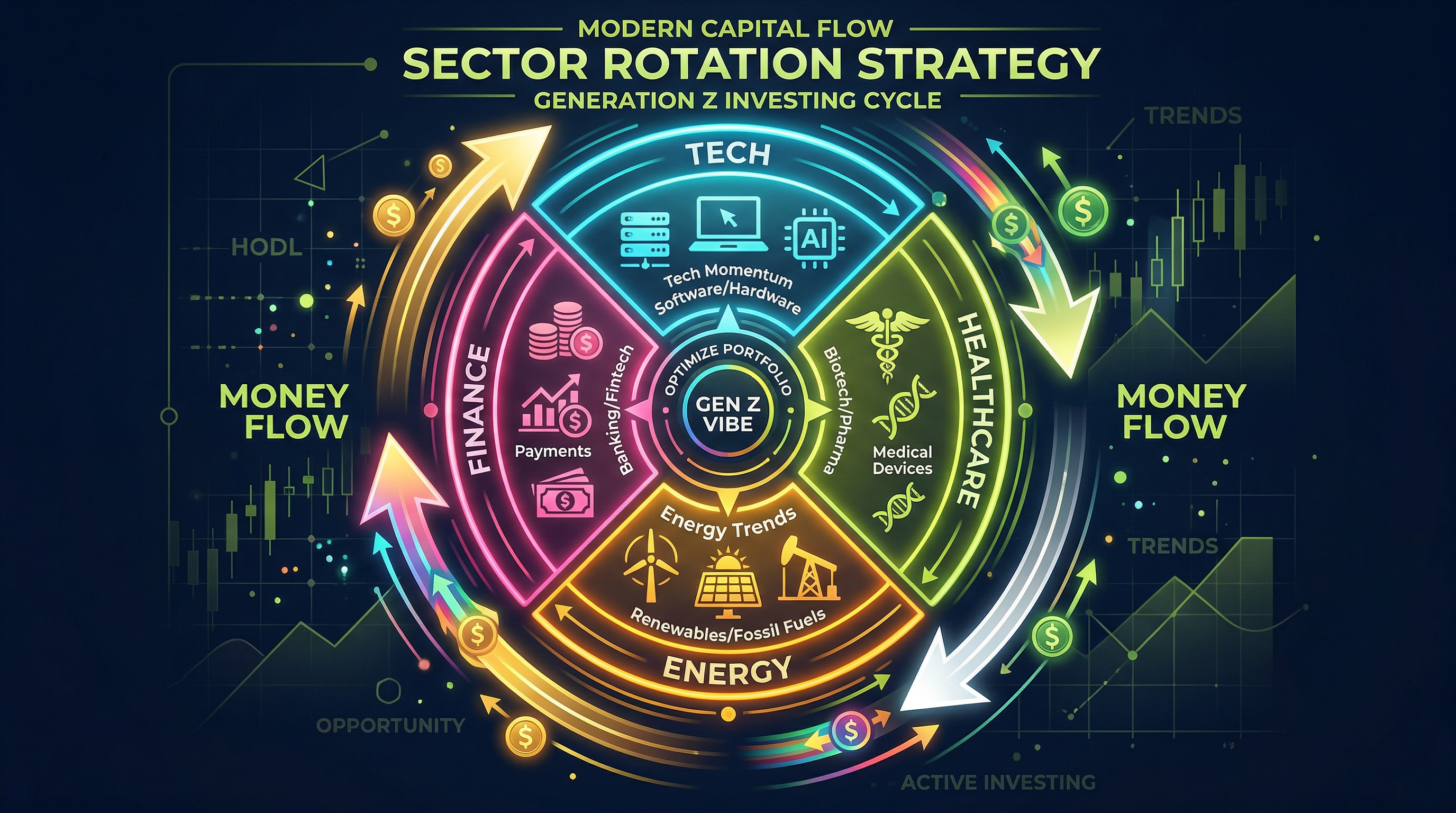
If you've ever wondered why healthcare stocks randomly start outperforming tech stocks for a few months, or why energy stocks take off right when consumer discretionary slumps — that's sector rotation in action. Understanding this concept is like getting a bird's-eye view of where institutional money is flowing, and it can give retail traders a significant edge in stock selection. Here's the playbook.
What Is Sector Rotation?
The U.S. stock market is divided into 11 sectors: Technology, Healthcare, Financials, Consumer Discretionary, Consumer Staples, Industrials, Energy, Materials, Utilities, Real Estate, and Communication Services. Institutional investors (pension funds, hedge funds, mutual funds) constantly shift their allocations between these sectors based on economic conditions, interest rates, and market cycle positioning.
Sector rotation is the systematic movement of capital from one sector to another as economic conditions change. Different sectors perform best at different stages of the economic cycle — understanding which sectors lead in which environment gives you a macro framework for stock selection.
The Economic Cycle and Sector Performance
The economy moves through roughly predictable phases: early expansion, mid expansion, late expansion, contraction (recession), and recovery. Each phase favors different sectors.
Early Expansion (Recovery)
Coming out of a recession, the sectors that tend to lead are: Consumer Discretionary (people start spending again), Technology (capital spending picks up), and Financials (lending activity recovers). Interest rates are typically low, and growth expectations are rising. In 2026, many analysts argue the market is in this phase after the 2024 correction.
Mid Expansion (Bull Market Peak)
Technology and Communication Services continue to lead. Industrials and Materials join the leadership as capex (capital expenditure) accelerates. Economic data is consistently strong. This is the longest phase of the cycle and where the broadest gains occur.
Late Expansion (Pre-Recession)
Energy often leads as demand is strong but supply is constrained. Consumer Staples start performing better (defensive positioning). Interest rates are rising, putting pressure on rate-sensitive sectors like Real Estate and Utilities. Healthcare begins outperforming as investors seek stability.
Contraction (Recession)
Defensive sectors dominate: Consumer Staples (people still need food and soap), Utilities (electricity demand is inelastic), and Healthcare. Growth sectors like Tech and Consumer Discretionary underperform significantly. Cash and defensive assets are king.
You don't need to predict economic phases perfectly — you need to recognize which phase you're in and act accordingly. The key signal is relative strength: which sectors are consistently outperforming the S&P 500 right now? That tells you where money is flowing. Track relative strength across sectors weekly using Traderise's market tools.
How to Track Sector Rotation in Real Time
Relative Strength Analysis
Compare each sector ETF's performance against SPY (S&P 500) over different timeframes: 1 month, 3 months, 6 months. Sectors consistently beating SPY across multiple timeframes are showing positive relative strength — money is flowing into them. Sectors lagging SPY are where money is leaving.
The 11 Sector ETFs to Watch
SPDR sector ETFs make this easy: XLK (Tech), XLV (Healthcare), XLF (Financials), XLY (Consumer Discretionary), XLP (Consumer Staples), XLI (Industrials), XLE (Energy), XLB (Materials), XLU (Utilities), XLRE (Real Estate), XLC (Communication). Plot each against SPY weekly to see which sectors are gaining or losing relative strength.
Practice This Strategy Risk-Free
Traderise lets you paper trade with $10,000 in virtual funds using real market data. Test every strategy in this article before you risk a single real dollar.
Start Paper Trading FreePractical Sector Rotation الاستراتيجيات
Strategy 1: Follow the Leaders
Each week, rank all 11 sectors by their 1-month and 3-month relative performance vs. SPY. Focus your stock picking in the top 3 sectors by relative strength. Ignore stocks in the bottom 3 sectors regardless of how good the individual chart looks. Swimming upstream against a weak sector is hard; swimming with a strong sector tide lifts all boats.
Strategy 2: Sector ETF Rotation
Simpler approach: instead of picking individual stocks, just rotate between the top 2–3 sector ETFs based on relative strength. Rebalance monthly. This reduces stock-picking risk entirely and captures sector momentum directly. Academic research shows simple sector rotation strategies have historically outperformed buy-and-hold S&P 500 on a risk-adjusted basis.
Strategy 3: Anticipating the Next Rotation
More advanced: try to position in sectors just before they start outperforming, based on economic signals. Example: if interest rates are starting to peak, rate-sensitive sectors like REITs and Utilities may start recovering soon — getting in before the rotation is obvious means better entry prices. This requires solid macro awareness but can be very profitable.
Sector Rotation in 2026: What's Leading Now
In early 2026, based on visible institutional flows: Technology (especially AI infrastructure) and Financials are showing the strongest relative strength. Healthcare and Consumer Discretionary are showing emerging strength. Energy is recovering after underperformance. Utilities and Real Estate are lagging, suggesting the market isn't in full defensive positioning yet.
Use Traderise to track live sector performance and build relative strength rankings into your weekly market analysis routine. Understanding where the sector winds are blowing is one of the highest-leverage inputs to your overall trading strategy.
Track Sector Rotation on Real Market Data
Use Traderise to monitor sector relative strength, build rotation models, and practice sector ETF strategies with paper trading — before shifting real capital between sectors.
جرّب Traderise مجاناً