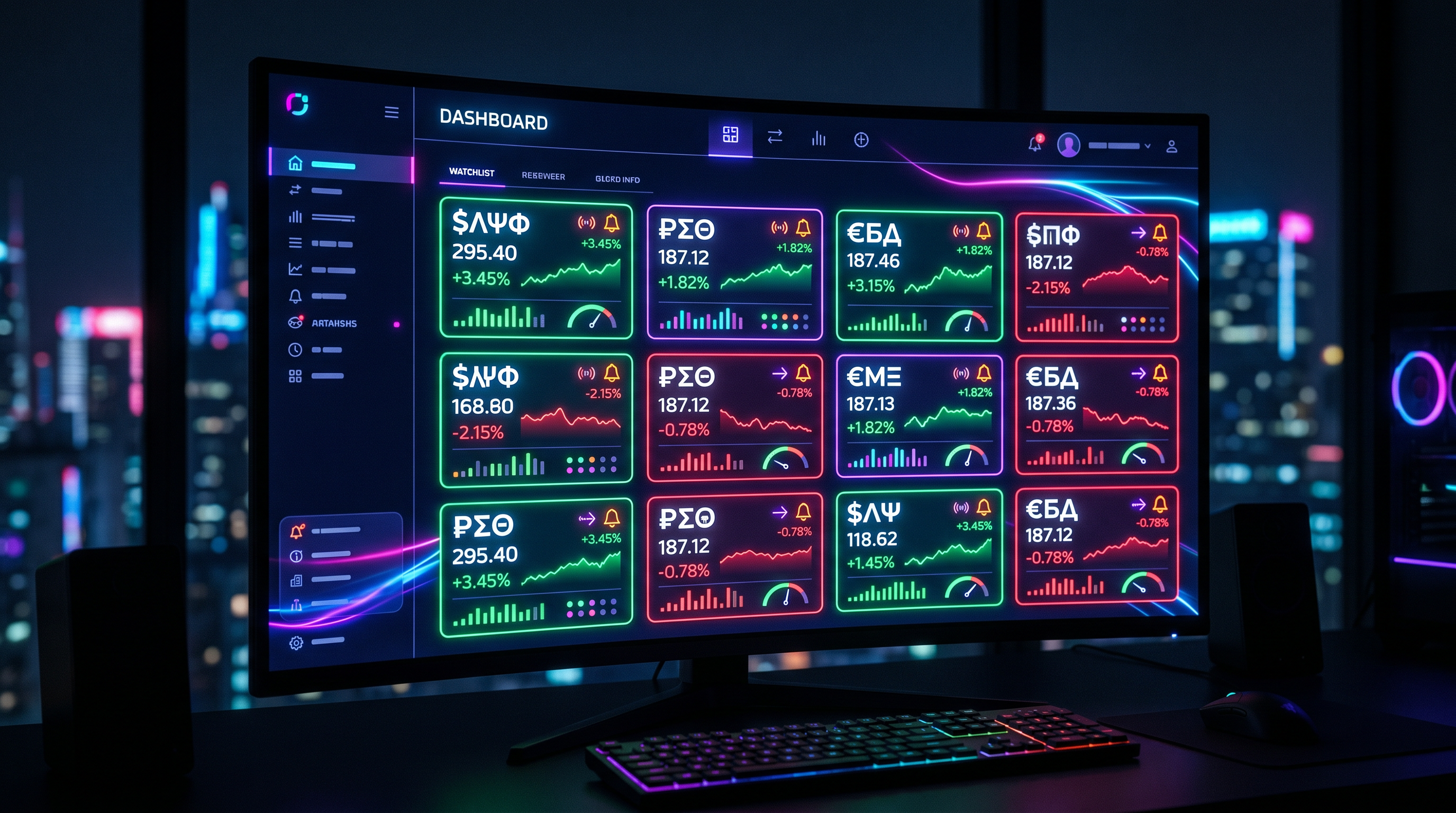
Every trader I've ever talked to who's actually consistent — not just lucky — has one thing in common: a real watchlist. Not a Pinterest board of hot tickers they saw on Reddit. Not fifty stocks dumped into a brokerage account at random. An actual, structured, purpose-built stock watchlist that tells them exactly where to look when the market opens.
I didn't have one when I started. I had a chaos list. Fifty symbols, no organization, no plan. AAPL next to some random biotech penny stock next to a Chinese EV company I definitely couldn't name the products of. The result? I'd open my platform every morning and have no idea what I was actually watching. So I'd react to whatever moved. And reacting instead of preparing is how you lose money slowly and consistently.
Here's how I actually build my stock watchlist now — the system, the criteria, the tools, and the weekly routine that keeps it sharp.
Why You Need a Stock Watchlist (And What Happens Without One)
A watchlist isn't about tracking stocks you like. It's about filtering the entire market down to a short list of names where you've already done the work — the levels are marked, the thesis is clear, and all you're waiting for is the setup. Without that filter, you're subject to what I call the ticker scroll trap: constantly refreshing, reacting to headlines, and trading based on whatever caught your eye in the last ten minutes.
The research backs this up. A focused watchlist improves clarity, reduces impulse trades, and helps you spot entry points faster because you're monitoring familiar names with defined parameters — not discovering a new stock and trying to make a same-day decision on it. That's not trading. That's gambling with extra steps.
The other thing a watchlist does is force you to develop conviction. You don't put a stock on your list because it's trending on X. You put it there because you understand the business, you know its key levels, you've watched how it reacts to news. That depth is what separates a trade from a coin flip.
The Two-List System: Core Watchlist + Daily Momentum List
The framework I use comes from how professional traders organize their attention — and it's the single biggest change I made to my own process. Instead of one giant list, you maintain two separate watchlists with completely different purposes.
List 1: The Core Watchlist (15–30 stocks)
This is your foundation. These are stocks you know deeply — names you've studied on weekends, levels you can recall from memory, sectors you actually understand. Your core list changes slowly. Stocks get added when they develop real technical structure, and removed only when that structure breaks down permanently.
What goes here: high-liquidity names with average daily volume (ADV) of at least 1 million shares, active options markets with tight bid-ask spreads, and clear technical structure — support and resistance levels the stock has respected repeatedly. I organize mine by sector, keeping one or two quality names per sector so I have coverage across the market without any single sector dominating my attention.
If you're building your first core list, start with the sector ETF leaders — the stocks with the largest weighting in major sector ETFs like XLK (tech), XLF (financials), XLE (energy). AAPL, MSFT, NVDA, JPM, XOM — you know these companies, which means you already have a head start on understanding their behavior.
List 2: The Daily Momentum List (5–10 stocks)
This list gets rebuilt every single morning. These are the stocks with something happening today: an earnings release, a news catalyst, unusual pre-market volume, or a gap. They don't need to have amazing fundamentals. They need to be moving — and moving for a reason.
Every morning, I run through the Traderise screener to populate this list fast. By 9:15 AM ET, before the open, I want my daily list finalized with key levels marked and entry plans sketched out. Flying blind into the open because you were still building your list at 9:29 is a great way to make bad trades.
Use Traderise to Screen and Track Your Watchlist
Traderise gives you real-time screening, pre-market gap alerts, and watchlist management across stocks, forex, and crypto — all in one place.
Try Traderise Free →How to Screen Stocks for Your Watchlist
Screening is how you go from 8,000+ publicly traded US stocks to a manageable shortlist. Here are the parameters I actually use — not just the textbook ones:
Average Daily Volume (ADV) ≥ 1 million shares. This is non-negotiable for me. Low-volume stocks have wide bid-ask spreads, meaning you're paying a hidden tax on every trade just to get in and out. With ADV over 1M, fills are clean, and you can exit quickly if a trade goes wrong. For your daily momentum list, I'd even push this to 2M+ on the day of a catalyst, since thin volume on a newsday is a red flag, not an opportunity.
Gap thresholds for momentum candidates. For pre-market activity, any stock gapping more than 3% with significant pre-market volume is worth a look for the daily list. For a confirmed play, I want to see 5%+ gapping with a real news catalyst behind it — not just a tweet. I run this scan between 8:00–8:30 AM ET using the Traderise gap screener.
Relative volume (RVOL) above 1.5x. Relative volume compares today's volume to the average volume at the same time of day. If a stock is trading at 2x its normal volume by 10 AM, something's happening. I use RVOL as a confirmation tool — a big price move with low relative volume is suspicious. A moderate move with 2x–3x relative volume is real.
Price above the 20-day moving average. For core list candidates, I want to see stocks trading in an uptrend — specifically, above their 20-day moving average. This isn't a magic filter, but it does exclude stocks that are in freefall and likely to offer more traps than setups.
RSI between 40–65 for swing entries. I don't want to buy overbought stocks for the core list. If RSI is above 70, the easy money has already been made and I'm potentially buying someone else's exit. Between 40–65 is the sweet spot: the stock has momentum but isn't stretched.
Here's a quick screening template to get started:
| Parameter | Core List | Daily Momentum List |
|---|---|---|
| Avg Daily Volume | ≥ 1M shares | ≥ 1M shares (2M+ preferred) |
| Pre-market Gap | N/A | 3% watch / 5%+ confirmed |
| Relative Volume | ≥ 1x (baseline) | ≥ 1.5x (confirmation) |
| Price vs 20-day MA | Above (uptrend) | Flexible (catalyst-driven) |
| RSI Range | 40–65 (swing entries) | Any (momentum plays) |
Setting Alerts That Actually Matter
Alerts are the difference between a watchlist and a job. Without them, you're manually checking prices every five minutes — and you're going to miss entries or get shaken out by noise. With the right Traderise alert system, your watchlist works for you while you're doing other things.
Here's how I structure my alerts:
Support bounce alerts: Set 1–2% above the support level, not at it. If NVDA has strong support at $900, I set an alert at $909. That gives me time to pull up the chart, confirm the level is holding, and make a deliberate entry — instead of getting a ping at $900 and panic-buying into the exact low.
Breakout alerts: Set at the top of the consolidation range or prior swing high. And here's the key: I always add a volume condition mentally. A price alert without volume confirmation is just noise. I want price and volume moving together. A stock breaking out on 3x average volume is a breakout. A stock drifting past resistance on low volume is a trap.
Stop-loss trigger alerts: Set at my stop level. If a trade goes against me and hits this alert, I close — no second-guessing, no "let me see if it bounces." The alert is a signal that my thesis was wrong.
Volume spike alerts: Set for 3x average daily volume by 10 AM. A stock not on my radar that suddenly gets 3x volume at the open often means something big is happening. This is how I catch late-breaking setups for the daily momentum list.
A price alert without context is just a notification. Set your alerts 1–2% before key levels, not at them — so you arrive at the decision point early, not breathless and chasing.
Mini Watchlist Template: What My Core List Actually Looks Like
Here's a simplified version of how I format my core watchlist. For every stock, I track more than just the ticker:
| Ticker | Sector | Key Support | Key Resistance | Status | Next Catalyst |
|---|---|---|---|---|---|
| AAPL | Tech | $195 | $215 | Watching | Earnings May |
| NVDA | Semiconductors | $875 | $940 | Ready to Trade | At support |
| JPM | Financials | $230 | $255 | Watching | Fed Decision |
| XOM | Energy | $118 | $128 | Watching | Oil inventory |
| MSFT | Tech | $420 | $445 | Ready to Trade | Near breakout |
The "Status" column does a lot of work here. "Ready to Trade" means I have a specific entry setup in mind — the stock is near a key level, and I'm watching for a trigger. "Watching" means I like the stock but it's not in a tradeable position yet. Adding this column stops me from forcing trades on stocks that just aren't set up.
I also note the next catalyst for each name — an earnings date, a Fed decision, a product launch. Catalysts can dramatically change how a stock behaves around key levels, so I need to know when they're coming before I enter a trade.
Watchlist Tools Compared: What I Actually Use
There's no shortage of options here, and the right tool depends on what kind of trader you are. Here's an honest comparison of what I've tested:
Traderise — My daily driver. The watchlist management is clean, the screener handles gap filters and relative volume without needing to manually configure everything from scratch, and the alert system is genuinely reliable. Best all-in-one option for active traders who don't want to juggle three platforms. The paper trading integration also means you can test a watchlist strategy without committing real capital.
TradingView — Best-in-class for charting and technical analysis. The free tier gives you one watchlist, but the Pro plan ($24.95/month) unlocks 4 chart layouts and up to 100 alerts. If you're technical-focused and want to draw levels, mark zones, and save chart templates per ticker, TradingView is hard to beat. The community features (published ideas, Pine Script) are a bonus if you want to dig deeper.
Finviz — Fast, visual, and good for initial scanning. The free version shows delayed data but is surprisingly powerful for building a screened list. Finviz Elite ($40/month) adds real-time data and alerts. Best for the screening phase — I use it to generate candidates, then move them to Traderise for daily management.
Yahoo Finance — Free and mobile-friendly, with unlimited watchlists and decent news integration. Good for casual monitoring and fundamental data, but the alerts are basic and the charting is limited. If you're just starting out and not yet actively trading, Yahoo Finance is totally fine.
Koyfin — Excellent for fundamental investors. 500+ metrics, 10+ years of historical data, institutional-grade analysis. If your watchlist is built around earnings quality and valuation, not tape-reading, Koyfin is the professional tool here. Free tier available; paid plans from $39/month.
| Tool | Best For | Price | Alerts |
|---|---|---|---|
| Traderise | Active trading, all-in-one | Free tier available | Yes, reliable |
| TradingView | Charting, technical analysis | Free / $24.95+/mo | Yes (100 on Pro) |
| Finviz | Screening, candidate discovery | Free / $40/mo Elite | Elite only |
| Yahoo Finance | Beginners, casual tracking | Free / paid tiers | Basic |
| Koyfin | Fundamental investors | Free / $39+/mo | Yes |
The Weekly Review Routine That Keeps Your Watchlist Sharp
A watchlist without a maintenance routine is just a list that gets staler every week. Every Sunday evening, I spend 30–45 minutes doing a proper review. Here's exactly what I do:
Prune ruthlessly. Any stock that:
- Broke below its key support level on high volume
- Moved so far past my entry target that the setup is gone
- Had its sector shift to significant underperformance (down 5%+ for the week while the broader market held)
- Offered no real setup for three consecutive weeks
...gets removed. No sentiment, no sunk cost. If a stock isn't offering setups, it's taking up mental bandwidth that belongs on something that is.
Add with intention. I run my swing screener once a week to surface new candidates. Before anything goes on the core list, I want to see: 1) a clear reason why this stock is interesting right now, 2) identifiable key levels on the chart, and 3) an ADV of at least 1M. New candidates often go on a "probationary" monitoring list first before earning a core list spot.
Check upcoming earnings and events. The earnings calendar for the next two weeks is essential. If a core list name has earnings coming up, I need to decide in advance whether I'm holding through the report, closing before, or waiting until after the dust settles to look for a setup. Getting surprised by earnings while you're in a position is avoidable — so avoid it.
Update your key levels. Markets move. A support level from three weeks ago might not be the relevant level today. Every Sunday, I re-mark the charts for all core list names and adjust my alerts to reflect current structure, not old assumptions.
This routine takes less time than you'd expect once you're in the habit, and it dramatically changes the quality of your Monday morning preparation. Instead of starting the week with a stale list and no plan, you start with a clean, current set of names where you already know what you're looking for.
Real Example: How This Played Out with NVDA
Let me make this concrete. A few weeks ago, NVDA had been on my core list for months — I know the stock, I know its levels. Support was well-established around $875. I had a Traderise alert set at $884 (about 1% above support).
On a Tuesday morning, the alert fired at 8:47 AM — pre-market. I pulled up the chart. NVDA was sitting right at $880 with pre-market volume already running 1.8x average. The broader market futures were flat. There was no major news on the name — just organic movement back to a level I already knew was important.
Because the stock was on my core list, I didn't need to do emergency research. I knew the support. I knew my entry. I knew my stop ($862, below the prior swing low) and my target ($920, prior resistance). The math on risk-reward was clean — about 2.5:1. I put the position on in the first 30 minutes of trading and closed it near $915 three days later.
That's what a real watchlist does. It turns the market from a reactive firehose into a list of situations you've already thought through — where execution becomes the easy part because the preparation already happened.
Build and Track Your Watchlist on Traderise
Traderise has real-time screening, gap alerts, relative volume filters, and watchlist management — everything you need to run the two-list system without juggling platforms.
Start Free on Traderise →The Bottom Line
Building a stock watchlist that actually finds trades comes down to structure. You need two lists — a stable core of 15–30 stocks you know deeply, and a lean daily momentum list of 5–10 names rebuilt every morning based on what's actually happening in the market that day. You need real screening criteria (ADV ≥ 1M, gap thresholds of 3% and 5%, relative volume confirmation). And you need a Sunday evening routine that prunes what's dead and refreshes what's alive.
The watchlist isn't a portfolio. You're not invested in these stocks. You're invested in the process of being prepared — so when the setup you've been waiting for shows up, you're already in position to take it instead of scrambling to figure out what you're looking at.
That's the whole game. The traders who are consistently profitable aren't smarter than you. They just show up more prepared.