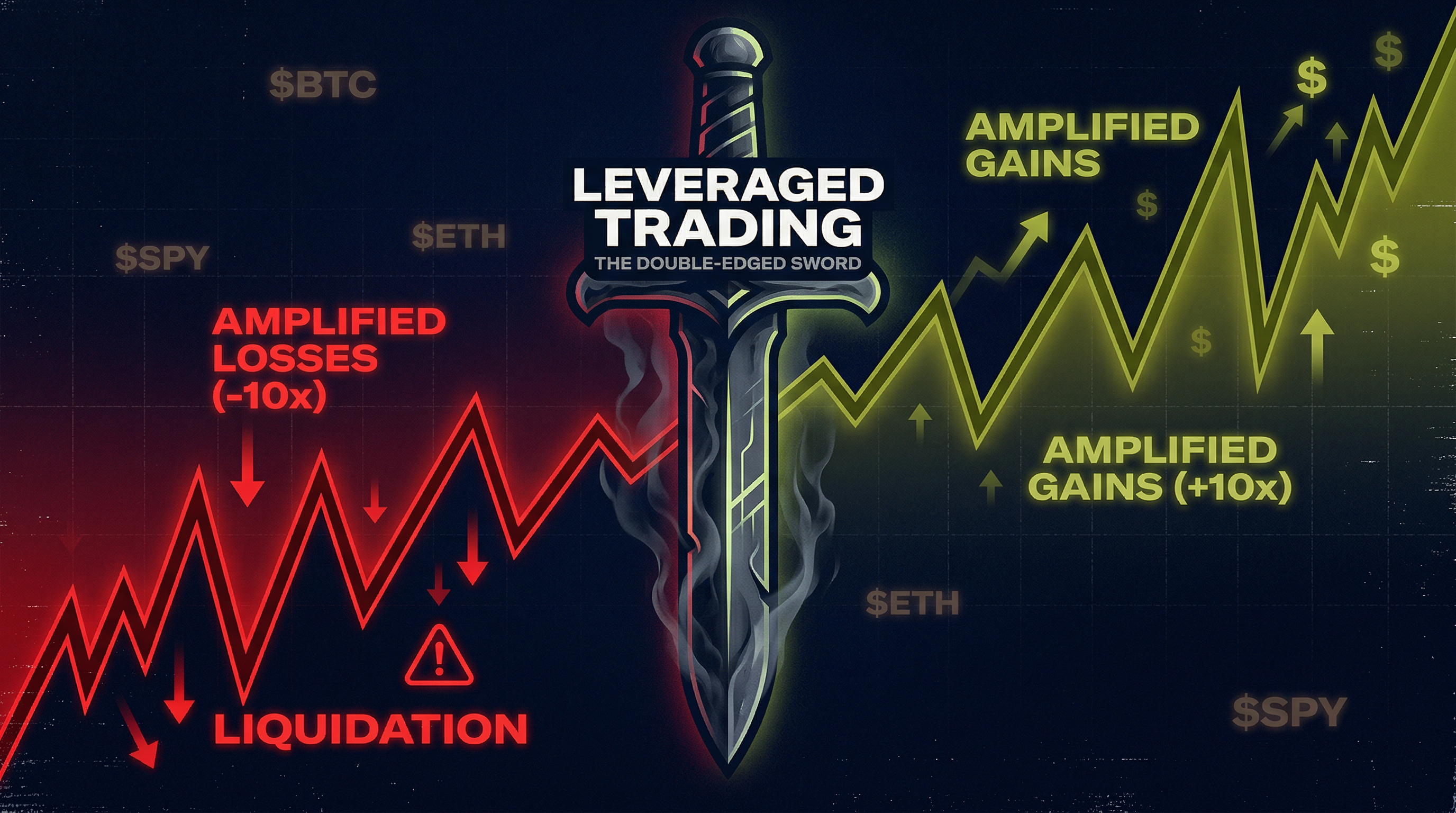
Margin trading is one of those features that brokers make way too easy to turn on and way too hard to understand the consequences of. With one click, you can have 2x the buying power in your account. It sounds like an upgrade. It can be. It can also be the fastest way to lose not just your investment, but money you didn't even have. This is the honest guide nobody puts in the onboarding email.
What Is Margin Trading?
Margin trading means borrowing money from your broker to buy more securities than your cash balance allows. With a 2:1 margin ratio, a $5,000 account can control $10,000 worth of stock — you own $5,000 in assets and owe $5,000 to your broker. The broker charges interest on what you borrow (usually 4–10% annually, varying by broker and amount).
The Appeal: Amplified Gains
If you buy $10,000 of stock with $5,000 of your own money and the stock rises 10%, you've made $1,000 — a 20% return on your actual capital. Leverage doubled your return. That's genuinely attractive, and it's why margin trading exists.
The Reality: Amplified Losses
If that same $10,000 position falls 10%, you've lost $1,000 — a 20% loss on your actual $5,000. If it falls 50%, you've lost $5,000 — your entire investment — and you still owe the broker their $5,000. A 50% move needs to happen for a fully margined position to wipe you out entirely. 50% moves happen more often than beginners expect.
The Margin Call: The Nightmare Scenario
A margin call is one of the most stressful experiences in trading. Here's how it happens: You have $5,000 in equity and $5,000 borrowed, controlling $10,000 in stock. The stock drops significantly. Your equity shrinks. When your equity falls below the broker's maintenance margin requirement (usually 25%), you receive a margin call — the broker demands you deposit more money or they will sell your positions for you, at whatever the current price is, immediately.
The cruel timing of margin calls: they almost always happen during rapid market declines — exactly when you'd want to hold and wait for a recovery. Instead, you're forced to sell at the worst possible time, locking in losses that a non-margined investor could have waited through.
Beginners should not use margin. Full stop. Master trading with cash first — learn to be consistently profitable over 6–12 months before considering leverage. Using margin before you're profitable amplifies losses just as efficiently as gains. When you do eventually use margin, keep it small (1.2–1.3x leverage, not 2x) and always know your margin call trigger price before entering. Practice on Traderise without margin first.
Types of Margin Accounts
Regulation T Margin (Standard Margin)
The standard margin account in the U.S., regulated by the Federal Reserve. Allows up to 2:1 leverage on stock purchases — you can borrow up to 50% of a stock's purchase price. This is the most common margin account type for retail traders.
Portfolio Margin
Available to traders with $125,000+ in their accounts, portfolio margin calculates leverage based on the overall risk of your entire portfolio rather than individual position limits. It can offer higher leverage for well-diversified portfolios. This is not a beginner tool.
Day Trading Margin (4:1)
Pattern Day Traders (those making 4+ day trades per week) can access 4:1 intraday leverage — controlling $4 of stock for every $1 of equity. This is extremely dangerous for beginners. A stock moving 25% against a fully leveraged day trading position wipes out the account entirely. Day trading margin should only be used by experienced traders with very tight risk management.
Practice This Strategy Risk-Free
Traderise lets you paper trade with $10,000 in virtual funds using real market data. Test every strategy in this article before you risk a single real dollar.
Start Paper Trading FreeWhen Margin Trading Can Actually Make Sense
For experienced traders with demonstrated profitability, modest margin use can make sense in specific situations:
- Temporarily bridging a settlement period (using margin to buy while waiting for a recent sale to settle)
- Minor leverage (1.2–1.3x) on high-conviction, well-positioned trades with very tight stops
- Professional hedging strategies where the leverage is offset by offsetting positions
Even in these cases, the cardinal rule: always know your margin call price before entering, and make sure a 10–15% adverse move cannot trigger it.
The Alternatives to Margin
If you want leverage without margin's unlimited loss risk, consider:
Options: Defined-risk way to control larger positions. Your maximum loss is capped at the premium paid.
Leveraged ETFs: 2x and 3x ETFs provide leverage without margin interest or margin calls. Trade them like regular ETFs. Warning: volatility decay makes leveraged ETFs inappropriate for holding periods over a few days.
For most Gen Z investors building wealth, the correct answer is: no margin, ever, until you've demonstrated consistent profitability for at least a year. Build your account through profitable trading and regular contributions, not through borrowed money. Use Traderise to build your skills on cash accounts first.
Build Skills Before You Add Leverage
Become consistently profitable with cash trading on Traderise's paper trading platform first. Build the foundation that makes leverage an amplifier of success instead of an accelerator of failure.
Try Traderise Free