I remember the first time someone mentioned options trading to me. My brain immediately went to one of two places: either "that's gambling for rich people" or "isn't that how some dude on Reddit turned $500 into $50,000 and then lost it all the next day?" Both of those images are technically accurate for a tiny slice of options trading. But the reality? Options are one of the most flexible, powerful tools in any trader's toolkit — and you don't need a finance degree or a trust fund to use them.
The problem is that most options guides are written by people who forgot what it's like to not know what a "strike price" means. They throw around terms like "implied volatility" and "theta decay" in the first paragraph and expect you to keep up. I'm not doing that here. We're starting from absolute zero — what an option actually is, why anyone would trade one, the two basic types, how they're priced, and a handful of strategies that won't require you to babysit a screen for 14 hours a day.
If you've been curious about options but felt intimidated, this is your entry point. No gatekeeping, no jargon walls. Let's go.
What Is an Option, Actually?
An option is a contract. That's it. It gives you the right — but not the obligation — to buy or sell a stock at a specific price before a specific date. You're paying for the right to make a decision later.
Think of it like putting down a deposit on a sneaker drop. You pay $20 to reserve a pair of Jordans at $180. If the shoes end up reselling for $350, you exercise your right, buy them at $180, and pocket the difference. If they sit on shelves and nobody wants them, you just lose your $20 deposit. That's essentially how a call option works.
The key terms you need to know right now:
Premium: The price you pay for the option contract itself. This is your maximum risk when buying options.
Strike price: The price at which you can buy (call) or sell (put) the underlying stock.
Expiration date: The deadline. After this date, your option is worthless if it hasn't been exercised or sold.
Underlying: The stock that the option is based on (AAPL, TSLA, SPY, etc.).
Contract size: One option contract represents 100 shares of the underlying stock.
That last point trips up a lot of beginners. When you see an option quoted at $2.50, the actual cost is $250 (because $2.50 x 100 shares). Always multiply by 100.
Calls vs. Puts: The Only Two Things You Need to Understand
Every single options strategy — no matter how complex it sounds — is built from just two building blocks: calls and puts.
Call Options
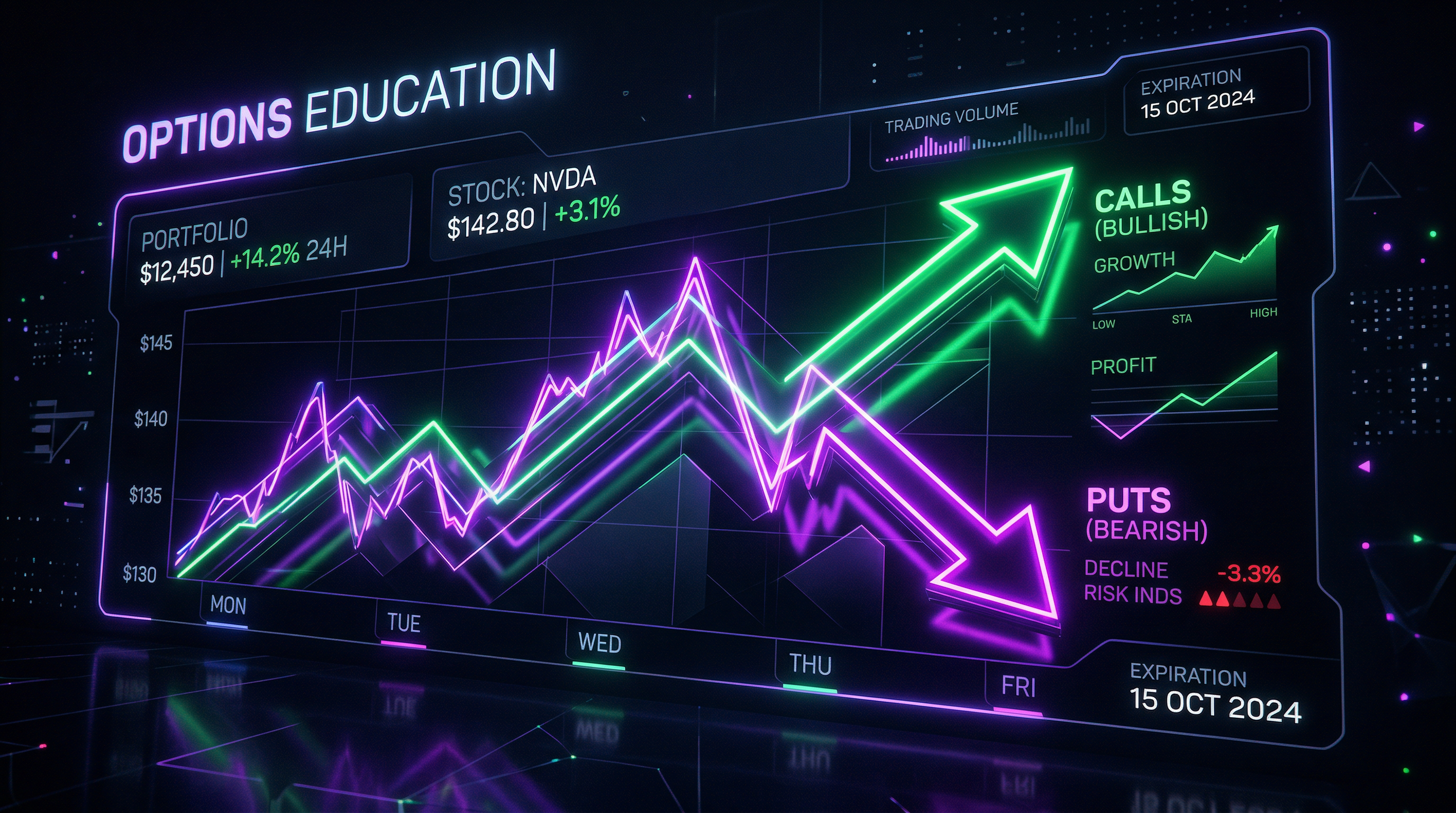
A call option gives you the right to BUY a stock at the strike price. You buy calls when you think the stock is going up.
Example: Apple is trading at $195. You buy a call option with a $200 strike price expiring in 30 days. The premium is $3.00, so you pay $300 for one contract. If Apple shoots up to $215 before expiration, your option is now worth at least $15 per share ($215 - $200 strike). That's $1,500 in value for your $300 investment — a 400% return. If Apple stays below $200? You lose your $300 premium. That's it. No more.
Put Options
A put option gives you the right to SELL a stock at the strike price. You buy puts when you think the stock is going down — or when you want to protect a position you already own.
Example: You own 100 shares of Tesla at $240. You're nervous about an earnings report. You buy a put with a $230 strike for $4.00 ($400 per contract). If Tesla drops to $200 after earnings, you can sell your shares at $230 instead of $200. The put saved you $2,600 (minus the $400 premium). If Tesla goes up instead? You lose the $400 premium but your shares are worth more. Think of it as insurance.
How Options Are Priced (Without the Math PhD)
Option pricing confused me for months until someone explained it in plain language. The premium you pay is made up of two things: intrinsic value and time value.
Intrinsic value is the real, tangible value of an option right now. If you have a $200 call and the stock is at $210, the intrinsic value is $10. If the stock is at $195, the intrinsic value is $0 — the option is "out of the money."
Time value is the extra amount you pay for the possibility that things could change before expiration. More time = more time value. This is why options with 90 days until expiration cost more than options expiring next week — there's more time for the stock to move in your favor.
Here's the critical concept that separates people who make money with options from people who don't: time value decays every single day. This is called "theta decay." An option that's worth $5.00 today might be worth $4.70 tomorrow even if the stock price doesn't move at all. The clock is always ticking. The closer you get to expiration, the faster the decay accelerates.
This is why buying weekly options and holding them overnight feels like watching ice melt on a hot sidewalk. Your position is shrinking even when nothing is happening.
The Greeks (Just the Two That Matter Right Now)
Options traders talk about "the Greeks" — delta, gamma, theta, vega, rho. You don't need to understand all of them on day one. Here are the two that actually affect your daily life as a beginner:
Delta: How much your option's price moves for every $1 move in the stock. A delta of 0.50 means your option gains $0.50 for every $1 the stock moves in your direction. Higher delta = more responsive to stock movement = more expensive.
Theta: How much value your option loses per day from time decay alone. A theta of -0.05 means you're losing $5 per contract per day just from time passing. This is the silent killer for option buyers and the profit engine for option sellers.
When you buy an option, time is your enemy — theta eats your position every day. When you sell an option, time is your best friend. Every beginner strategy decision should start with this question: am I paying for time, or am I getting paid for it?
3 Beginner-Friendly Options Strategies
Most beginners start (and end) with buying naked calls and puts. There's nothing wrong with that as a learning exercise, but it's the hardest way to make consistent money because you're fighting theta decay the entire time. Here are three strategies ranked by complexity and risk.
Strategy 1: Buying Long Calls (Bullish Bets)
This is the simplest options trade. You think a stock is going up, so you buy a call option.
When to use it: You have a strong directional conviction and want leveraged exposure without buying 100 shares.
Risk: Limited to the premium you paid.
Reward: Theoretically unlimited (stock can keep going up).
Beginner tip: Buy options with at least 45 days until expiration. This gives you time to be right without theta eating you alive. Avoid weekly options until you have at least 6 months of experience.
Example: SPY (S&P 500 ETF) is at $520. You think the market is going higher over the next month. You buy a $525 call expiring in 45 days for $6.00 ($600 per contract). If SPY hits $540, your call is worth at least $15 ($1,500) — a 150% return. If SPY drops or stays flat, you lose some or all of the $600.
Strategy 2: Cash-Secured Puts (Getting Paid to Wait)
This is my favorite beginner strategy because it flips the script. Instead of paying for an option, you sell one and collect the premium.
How it works: You sell a put option at a strike price where you'd be happy to buy the stock. You keep enough cash in your account to buy the shares if assigned.
When to use it: You want to buy a stock but think it's a little overpriced right now. You get paid to wait for a dip.
Risk: You might have to buy the stock at the strike price (but you wanted to buy it anyway).
Reward: You keep the premium regardless of what happens.
Example: You want to buy AMD, currently at $165. You sell a $155 put expiring in 30 days and collect $3.50 ($350). Two scenarios: AMD stays above $155 — you keep the $350 free and clear. AMD drops below $155 — you buy 100 shares at an effective price of $151.50 ($155 strike minus $3.50 premium). Either way, you win.
Strategy 3: Covered Calls (Income on Shares You Own)
If you already own 100 shares of a stock, you can sell a call option against them and collect premium.
How it works: You own 100 shares of Stock X. You sell a call option at a strike price above the current price. If the stock stays below the strike, you keep the premium and your shares. If it goes above, you sell your shares at the strike price (still at a profit).
When to use it: You're holding a stock long-term and want to generate income while you wait.
Risk: You cap your upside. If the stock rockets past your strike, you miss out on gains above that price.
Reward: Consistent premium income, month after month.
Example: You own 100 shares of MSFT at $430. You sell a $445 call expiring in 30 days for $4.00 ($400). If MSFT stays under $445, you pocket $400. If MSFT hits $460, you sell your shares at $445 (still a $15/share profit) plus keep the $400 premium. The only scenario where you "lose" is if MSFT goes to $500 and you sold at $445 — but you still made money, just not the maximum.
The 5 Mistakes That Blow Up Beginner Options Traders
I've talked to dozens of traders who started with options and quit within 3 months. Almost all of them made the same mistakes. Here's the pattern:
1. Buying too-short expirations
Weekly options are cheap for a reason — they expire fast and theta decay is brutal. A stock can move in your direction all week and you still lose money because time value evaporated faster than the stock moved. Start with 30-60 day expirations minimum.
2. Going all-in on a single trade
Options offer leverage, which means small amounts of capital can control large positions. That's exciting — and dangerous. Never risk more than 3-5% of your trading account on a single options trade. If you have $5,000, that's $150-$250 per trade maximum.
3. Ignoring implied volatility
This is the hidden trap. Right before earnings, implied volatility (IV) spikes because everyone expects a big move. Options premiums get inflated. After earnings, IV drops sharply ("IV crush"), and even if you got the direction right, your option can lose value. Buying options before earnings is playing on hard mode.
4. No exit plan
Before you enter any options trade, know two things: where you'll take profit, and where you'll cut your loss. A common approach: take profit at 50-75% of the option's value, cut losses at 50%. If you paid $300 for a call and it's worth $150, close it. Don't wait for it to go to zero hoping for a miracle.
5. Trading options you don't understand
If you can't explain a trade to a friend in 30 seconds, you shouldn't be in it. Stick with simple long calls, long puts, covered calls, and cash-secured puts until those feel automatic. Iron condors and butterfly spreads can wait.
How Much Money Do You Need to Start Trading Options?
Less than you think, but more than $50.
Technically, you can buy a single option contract for as little as $10-$20 (cheap, far out-of-the-money options). But those are lottery tickets, not trades. For a realistic options trading account, here's what I'd recommend:
$500-$1,000: Enough to buy long calls and puts on lower-priced stocks and ETFs. You can learn the mechanics without meaningful risk.
$2,000-$5,000: Comfortable range for buying options on popular stocks (AAPL, AMD, SPY). You can diversify across 3-5 positions.
$5,000+: Opens up selling strategies (cash-secured puts, covered calls) where you need more capital to cover potential assignments.
The best approach? Start on a paper trading simulator. Platforms like Traderise let you practice options trades with virtual money in real market conditions. You'll learn how theta decay actually feels, how quickly options can move, and whether your strategies hold up — all without risking a cent. I spent two months paper trading options before putting real money in, and it was the smartest thing I did.
Building Your First Options Trading Routine
Once you understand the basics, the question becomes: how do I actually start doing this consistently? Here's the weekly routine I wish someone had given me:
Sunday evening (15 minutes): Review the upcoming week. Check for any major earnings reports, Fed meetings, or economic data releases that could cause volatility. If a stock you're watching has earnings, avoid buying options on it until after the announcement.
Monday morning (10 minutes): Scan your watchlist. Look for stocks near key support or resistance levels. Check IV rank — is implied volatility high or low compared to the last year? High IV = better for selling strategies. Low IV = better for buying strategies.
Trade day (whenever you enter): Log every trade in a journal. Write down: the ticker, strike, expiration, premium paid/collected, your thesis, your profit target, and your stop loss. This takes 2 minutes per trade and will save you thousands of dollars over time.
Friday afternoon (10 minutes): Review open positions. Are any approaching expiration? Close them or roll them out to a further date. Never let options expire without a plan — weird things happen on expiration Friday.
Total time commitment: about 45 minutes per week for a beginner. You don't need to watch screens all day. Options actually work better when you set up a trade with a clear thesis and walk away.
Practice options trading risk-free
Traderise's paper trading mode lets you practice calls, puts, and strategies with virtual funds and real-time market data. Build your confidence before risking real money.
Try Traderise FreeThe Bottom Line
Options trading isn't gambling and it isn't reserved for Wall Street veterans. It's a skill — like learning to drive stick shift. The mechanics are simple once you understand them, but you'll stall out a few times before it clicks. And that's fine.
Start with the fundamentals: calls go up, puts go down, premiums decay over time. Nail those three ideas and you're ahead of 80% of people who open an options account. Then pick one strategy — I'd recommend cash-secured puts or covered calls — and practice it for 30 days before trying anything fancier.
The traders who blow up their accounts aren't the ones who didn't understand the theory. They're the ones who skipped the practice, sized too big, and traded strategies they couldn't explain. Don't be that person.
The market will be there tomorrow. Take your time, build the skill, and let the compounding do its thing. Options just give you more tools to make it happen.