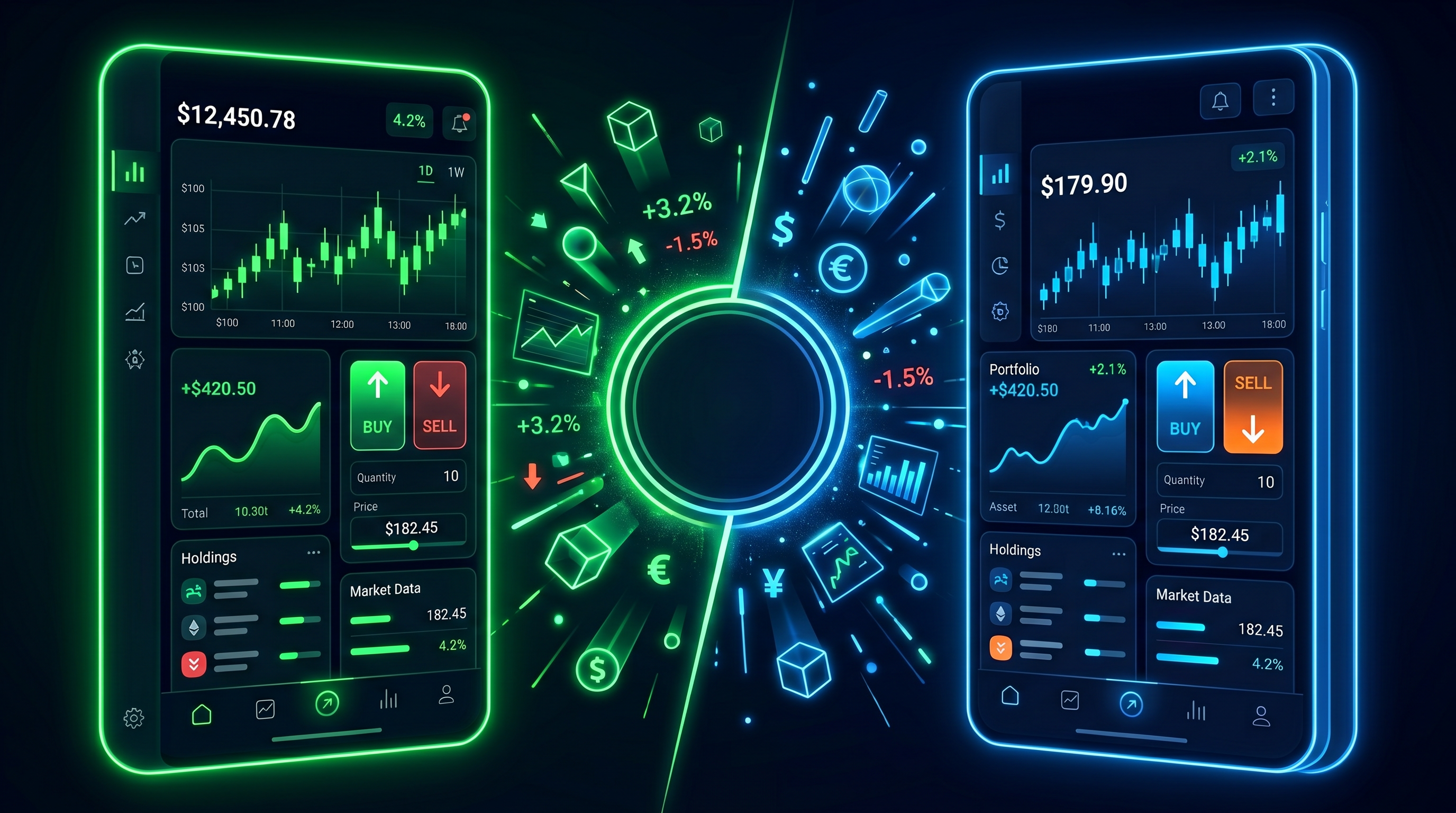
I downloaded both apps on the same phone, funded two accounts with the same amount of money, and spent weeks poking at every feature I could find. Robinhood and Fidelity are the two most-talked-about brokerage apps for beginners right now — and honestly, the answer to "which one should I use?" is not as obvious as the internet makes it sound.
Here's the thing: both apps are free to open, both offer $0 commission stock trades, and both have mobile apps that won't make you want to throw your phone. But they are built for fundamentally different versions of "beginner." Understanding that difference will save you a lot of frustration — and potentially a lot of money.
Let's get into it.
The Quick Summary: What Each App Is Actually For
Before we go feature-by-feature, you need to understand the philosophy behind each platform.
Robinhood was built to remove friction. The whole point is that investing should feel like using any other app on your phone — fast, clean, and immediate. It's mobile-first in a way that legacy brokers just aren't. Signing up takes about five minutes. You can buy fractional shares of Apple with $1. It's designed to get you in the market as fast as possible, with as little intimidation as possible.
Fidelity was built to be comprehensive. It's a 75-year-old financial institution that has spent the last five years aggressively modernizing its mobile experience — and it shows. Fidelity ranked #1 for Best Broker for Beginning Investors in NerdWallet's 2026 awards precisely because it offers things Robinhood simply doesn't: expense-ratio-free index funds, a massive mutual fund library, robust retirement tools, and 24/7 phone support you can actually reach a human through.
Neither is objectively "better." They're built for different goals — and I'll break down exactly which one fits yours.
Practice before you pick a broker
Before committing real money to any platform, Traderise lets you paper trade stocks, forex, and crypto with $10K in virtual funds and real-time data. Zero risk, real practice.
Try Traderise Free →Robinhood vs Fidelity: Fees Comparison
Let me put the actual numbers in front of you. This is the stuff that matters when you're first starting out.
| Fee Type | Robinhood | Fidelity |
|---|---|---|
| Account minimum | $0 | $0 |
| Stock & ETF trades | $0 | $0 |
| Options (per contract) | $0.50 (free: equity); $0.35 w/ Gold | $0.65 |
| Uninvested cash rate | 0.01% free / 3.5% Gold | 3.97% (no subscription needed) |
| IRA contribution match | 1% free / 3% Gold | None |
| Account transfer out (ACAT) | $100 | $0 |
| Inactivity / annual fee | $0 | $0 |
| Robinhood Gold | $5/mo or $50/yr | N/A |
The cash interest rate gap is the one that catches people off guard. On a free Robinhood account, your idle cash earns a measly 0.01%. Fidelity pays 3.97% on uninvested cash with no subscription required. If you're sitting on $5,000 waiting for the right entry, that's the difference between earning $0.50 per year and earning $198. That's real money.
The Robinhood Gold subscription ($5/month) closes that gap — you get 3.5% on cash and a 3% IRA match — but then you're paying $60/year for features Fidelity gives you for free.
The Hidden Fee Everyone Ignores: Payment for Order Flow
Robinhood makes a significant portion of its revenue from payment for order flow (PFOF) — routing your trades to market makers who pay for the privilege. This is legal and disclosed, but it means your trades may not always get the absolute best execution price. The difference is usually tiny (fractions of a cent per share), but it's worth knowing.
Fidelity explicitly does not accept payment for order flow for equities. They use their own order routing to seek best execution. According to StockBrokers.com's 2026 review, this is increasingly rare among major brokers and is a genuine client-first practice.
Features That Actually Matter for Beginners
Fees are just one piece. Here's how the two platforms stack up on the stuff you'll actually use day-to-day.
| Feature | Robinhood | Fidelity |
|---|---|---|
| Fractional shares | ✓ (from $1) | ✓ (from $1) |
| Mutual funds | ✗ | ✓ (3,220+ no-fee) |
| Zero expense-ratio index funds | ✗ | ✓ (FZROX, FZILX etc.) |
| Cryptocurrency | ✓ | ✓ |
| Futures trading | ✓ | ✗ |
| Retirement accounts | IRA only (Trad/Roth) | IRA, 401k rollover, 529, HSA |
| Robo-advisor | ✗ | ✓ (Fidelity Go — free under $25K) |
| Paper trading (practice) | ✗ | ✗ |
| Global ADRs / foreign stocks | 650+ ADRs | Wide selection |
One thing neither Robinhood nor Fidelity offers is a built-in paper trading (practice) mode. This is a genuinely underrated feature for beginners. If you want to get comfortable placing trades before you risk real money, you'll need a dedicated simulator — which is exactly what Traderise does well. It's worth bookmarking alongside whichever broker you choose.
Mobile Experience: Side-by-Side
I tested both apps on the same phone for weeks. Here's my honest take:
Robinhood's App
Robinhood's app is genuinely beautiful. The onboarding takes about five minutes, the interface is clean and uncluttered, and buying a stock feels as easy as ordering a pizza. The new Robinhood Legend desktop platform added in 2024 is actually solid too — multi-leg options, real-time data, customizable layouts. For someone who wants to focus entirely on active trading with a simple UI, Robinhood nails it.
The downsides: the educational content feels thin compared to Fidelity, and the app's simplicity can work against you — it's easy to make impulsive trades when there's no friction. That's not a bug for Robinhood. It's the design.
Fidelity's App
Fidelity's mobile app has improved dramatically. It doesn't have Robinhood's aesthetic polish, but it has depth — you can access full research reports from Argus, Zacks, CFRA, and S&P Global right from the app. The "Life Events" educational section is genuinely useful for beginners who want context around decisions like "should I open a Roth IRA?" not just "how do I place a trade?"
The only knock: Fidelity's app can feel overwhelming at first. There are a lot of menus. Give it two weeks and it clicks, but the first impression is busier than Robinhood.
| Mobile Experience | Robinhood | Fidelity |
|---|---|---|
| Onboarding time | ~5 minutes | ~10–15 minutes |
| UI cleanliness | Excellent | Good (gets better with use) |
| Research depth in app | Morningstar (Gold only) | Argus, Zacks, CFRA, S&P Global |
| Live earnings calls | ✓ (selected companies) | ✓ |
| Desktop platform | Robinhood Legend | Fidelity.com + Fidelity Trader+ |
Education and Learning Resources
This section is where it gets real for Gen Z investors. According to data from Motley Fool's 2026 Investor Outlook, 68% of Gen Z plan to increase their stock investing this year. Most of them are starting from close to zero knowledge. So: which app actually teaches you?
| Education | Robinhood | Fidelity |
|---|---|---|
| Article library | Basic | Extensive ("Life Events" framework) |
| Webinars / live events | ✓ | ✓ |
| Retirement planning tools | Basic | Excellent (calculators, goal tracking) |
| Advisor coaching calls | ✗ | ✓ (unlimited 30-min calls with $25K+) |
| In-person branches | ✗ | ✓ (200+ locations) |
Fidelity wins education, and it's not particularly close. The "Life Events" section alone — which covers things like "I just got my first job" or "I want to start saving for retirement" — is more useful for a beginner than anything Robinhood offers on the learning side.
The best broker for you is the one you'll actually use to learn — not just the one with the nicest app. If a slick UI makes you trade impulsively, that's a cost. If complex menus make you quit, that's a cost too. Match the tool to your actual behavior, not your ideal self.
Robinhood vs Fidelity for Retirement (IRA)
This is genuinely interesting territory, and it's where Robinhood has made a smart move that's worth paying attention to.
Robinhood's IRA accounts come with a 1% match on contributions for free accounts and 3% for Gold subscribers. Let's do the math: if you max out a Roth IRA at $7,000 in 2026, Robinhood gives you a free $70 — or $210 with Gold. No employer required. That's legitimately compelling for younger investors who don't have access to employer 401(k) matches.
The fine print: Robinhood can claw back some or all of the matched funds if you make withdrawals within five years. So this is a real benefit for long-term holders, not a trick to grab and run.
Fidelity has no IRA match, but its retirement ecosystem is dramatically broader. You get 529 college savings plans, HSAs, SEP-IRAs for freelancers, and rollover support. Its retirement calculators are sophisticated. And critically, Fidelity offers its own zero-expense-ratio index funds (FZROX for US total market, FZILX for international) — which means you can build a fully diversified, permanently free retirement portfolio in a way you literally cannot do at Robinhood.
For IRA investors: Robinhood wins on the short-term incentive (match), but Fidelity wins on the long-term infrastructure. If you're starting a Roth IRA with $100/month and plan to hold index funds for 30 years, Fidelity's platform and zero-fee funds will almost certainly serve you better.
Customer Support: The Real Test
You will eventually need help. A trade that won't execute, a deposit that hasn't cleared, a tax form that doesn't look right. Here's how both handle it:
Robinhood: 24/7 chat support, plus phone support Monday through Friday, 7am–9pm ET. When I tested their chat, I got a human within about three minutes at 9pm on a Tuesday. That's solid. Their in-app help center has improved substantially.
Fidelity: 24/7 phone, chat, email, and social media support. Plus 200+ physical branches. When I've needed Fidelity support in the past, getting a knowledgeable human on the phone has never taken more than a few minutes. For account issues involving real money, this matters more than most people realize until something goes wrong.
Fidelity wins support, plainly.
The Third Option Worth Knowing About
Here's something the Robinhood-vs-Fidelity conversation often skips: neither platform is designed for traders who want to practice or develop skills before going live. Both are live-trading-only environments. If you're still in the "I'm figuring this out" phase — and most beginners are, regardless of which broker they open — it's worth checking out Traderise as a complement to whichever broker you choose.
Traderise gives you paper trading across stocks, forex, and crypto in one platform with real-time market data. You can build confidence with a virtual portfolio before risking real money, which is the kind of learning environment neither Robinhood nor Fidelity provides. Think of it as the place you go to practice before you play.
Honest Pros and Cons
Robinhood Pros and Cons
Pros:
- Genuinely the cleanest, fastest mobile investing experience available
- IRA contribution match (1–3%) is a unique and valuable incentive
- Crypto, futures, and options all in one app
- Robinhood Gold unlocks competitive cash rates (3.5%) and cheaper options
- Fast account opening — live in minutes
Cons:
- 0.01% cash interest rate on free accounts (a meaningful drag on idle cash)
- No mutual funds — can't buy VTSAX, FXAIX, or similar
- No zero expense-ratio index funds
- $100 transfer-out fee if you want to move to another broker
- Thin educational content for true beginners
- App design optimized for trading frequency (more trades = more PFOF revenue)
Fidelity Pros and Cons
Pros:
- 3.97% on uninvested cash — no subscription required
- Zero expense-ratio index funds (FZROX, FZILX) — genuinely unique
- 3,220+ no-fee mutual funds
- Best-in-class educational tools and retirement planning resources
- No PFOF on equity orders — more transparent execution
- $0 account transfer out — zero lock-in
- 24/7 support with real humans and physical branches
Cons:
- No IRA contribution match
- Options cost $0.65/contract vs. Robinhood's lower rates
- App can feel overwhelming initially for absolute beginners
- No futures trading
- Onboarding takes longer than Robinhood
The Bottom Line: Which One Should You Actually Use?
After weeks of testing both, here's my honest take:
Choose Robinhood if: You want the fastest, simplest way to get started with stocks, ETFs, or crypto. You want to take advantage of the IRA match. You're comfortable with a purely mobile-first experience and don't need mutual funds or deep research tools. You plan to be active and want a clean interface that stays out of your way.
Choose Fidelity if: You're building a long-term portfolio and want access to zero-cost index funds, a full retirement account suite, and serious research tools. You care about your idle cash earning something real (3.97% beats most savings accounts right now). You're a true beginner who needs robust educational resources and might want to call a human when something confuses you.
And honestly? A lot of people in the STACKD community use both — Robinhood for quick stock trades and crypto, Fidelity for their IRA and long-term index fund investing. That's not a cop-out answer; it's what the data actually supports.
Whatever you pick: before you fund a live account with real money, spend at least a couple weeks practicing your strategy. Traderise's paper trading mode is the fastest way to learn without the tuition fees that come from real losses.
Test your strategy before going live
Start with Traderise's risk-free paper trading environment. Real market data, $10K virtual balance, stocks + crypto + forex in one place. Build the habits before the stakes are real.
Start Paper Trading Free →