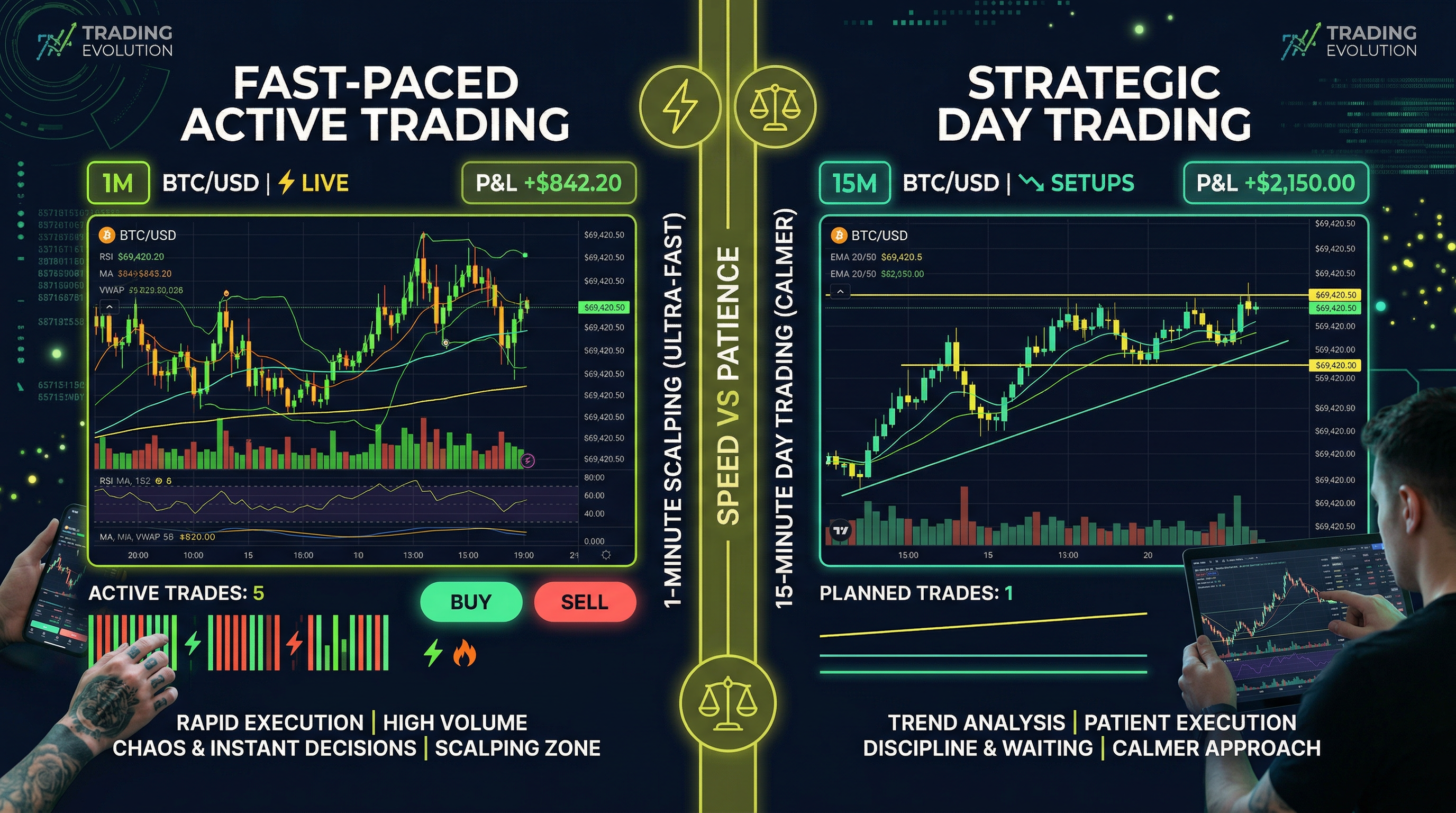
If day trading sounds intense, scalping sounds absolutely insane. We're talking holding positions for 30 seconds to 5 minutes, making $0.05–$0.20 per share on dozens of trades per day. My initial reaction: "that sounds like a terrible way to spend your morning." After 60 days experimenting with both, my opinion is more nuanced. Here's the real comparison, including the screen time math nobody talks about honestly.
Defining the Two Styles: Where the Lines Are
Day Trading
Day trading involves opening and closing positions within the same trading day. Hold times typically range from a few minutes to several hours. Traders look for intraday moves of 0.5–5%, targeting larger moves with fewer trades. A typical day trader might make 3–10 trades per day.
Scalping
Scalping is extreme short-term trading — in and out in seconds to minutes. Scalpers target tiny price moves (often just $0.05–$0.20 per share) and make up for the small margin per trade with volume. A scalper might make 20–100 trades per day, each held for mere minutes or less. The profit per trade is tiny; the compounding across many trades is the model.
Screen Time Reality Check
Here's where most comparisons get it completely wrong: people assume scalping requires MORE screen time than day trading. In my experience, it's the opposite — but not in the way you'd expect.
Day Trading Screen Time: 4–6 Hours
The problem with day trading is the waiting. You need to be at your screens from 9:30 AM onward, watching for setups. But most setups don't appear for minutes or hours. You're locked in, attention required, but often not actively trading. That sustained vigilance is cognitively exhausting. In my day trading month, I was mentally spent by 2 PM whether or not I'd made a single trade.
Scalping Screen Time: 1–2 Hours (Intense)
Pure scalpers I know focus exclusively on the first 60–90 minutes after the open (9:30–11:00 AM) and optionally the last 30 minutes (3:30–4:00 PM). These are the highest-volatility, highest-volume windows. After 11 AM, liquidity and volatility drop dramatically, making scalping much harder. Many scalpers literally close their platforms and do something else by 11 AM. Less total time — but what time exists is absolutely maximum intensity.
Scalping is not a beginner strategy despite the "small positions" framing. The speed of decision-making required, the execution precision needed, and the psychological stamina demanded make it one of the hardest trading styles to master. Build solid foundations with swing trading or standard day trading first. Use Traderise's paper trading platform to simulate both styles before committing real capital to either.
The Economics: Do the Numbers Actually Work?
Scalping Math
Typical scalp: $0.10 per share profit target, 500 shares, = $50 gross profit. After commissions (even "free" brokers have spread costs), realistic net might be $30–$40. Do 10 successful scalps: $300–$400 per day. But you also have losing scalps — with tight stops, individual losses might be $25–$35. Net of wins and losses, an experienced scalper might net $100–$200 per good session.
The catch: achieving 10+ successful scalps per session requires exceptional skill, fast execution technology, and the right market conditions. On most days, even experienced scalpers have flat or slightly negative sessions from the grind of commissions and spread.
Day Trading Math
Typical day trade: 0.5–2% move, 200 shares at $50 = $500 position, 1% move = $50 profit. Larger individual wins but fewer trades. A day trader making 3 good trades at average $80 net each grosses $240. Plus potentially one larger trade: $150–$200. Good day trading sessions can net $300–$500 for experienced practitioners.
Practice This Strategy Risk-Free
Traderise lets you paper trade with $10,000 in virtual funds using real market data. Test every strategy in this article before you risk a single real dollar.
Start Paper Trading FreeTechnology Requirements: The Hidden Barrier to Scalping
Scalping has a technology dependency that day trading doesn't. To scalp effectively:
- You need sub-second order execution — latency matters when you're holding for 2 minutes
- Level 2 data and a direct-access platform (not a standard retail interface)
- A fast, reliable internet connection (100ms of lag can cost you the entry)
- A second monitor (at minimum) to track multiple stocks and order flow simultaneously
Standard retail broker apps are not scalping platforms. Professional scalpers use direct-access platforms that route orders to specific exchanges for fastest execution. This infrastructure adds cost and complexity that most beginners aren't prepared for.
Which Should You Start With?
My honest recommendation based on 60 days of both:
Start with day trading if you want intraday active trading — specifically the longer-hold style (position held 30 minutes to several hours) that doesn't require split-second reflexes. This gives you feedback loops that are longer than scalping but shorter than swing trading, and the stakes per trade are high enough to learn meaningful lessons without the execution speed requirements of scalping.
Explore scalping later, specifically during the 9:30–11 AM window, once you've mastered chart reading, order flow basics, and emotional control. Paper trade it first — practice the rapid entry-exit cycle on Traderise's platform until you can execute consistently without hesitation before any real money is involved.
And if neither appeals to you, swing trading remains the highest-quality lifestyle choice for most people with real lives, real jobs, and a preference for trading well over trading constantly. Many very successful traders have built consistent income streams through swing trading alone, with Traderise's tools for analysis and setup identification.
Try Both Styles Before Committing
Paper trade scalping and day trading strategies on Traderise with $10,000 in virtual capital. Compare your results and stress levels across both styles — the data will tell you which suits your life.
Try Traderise Free