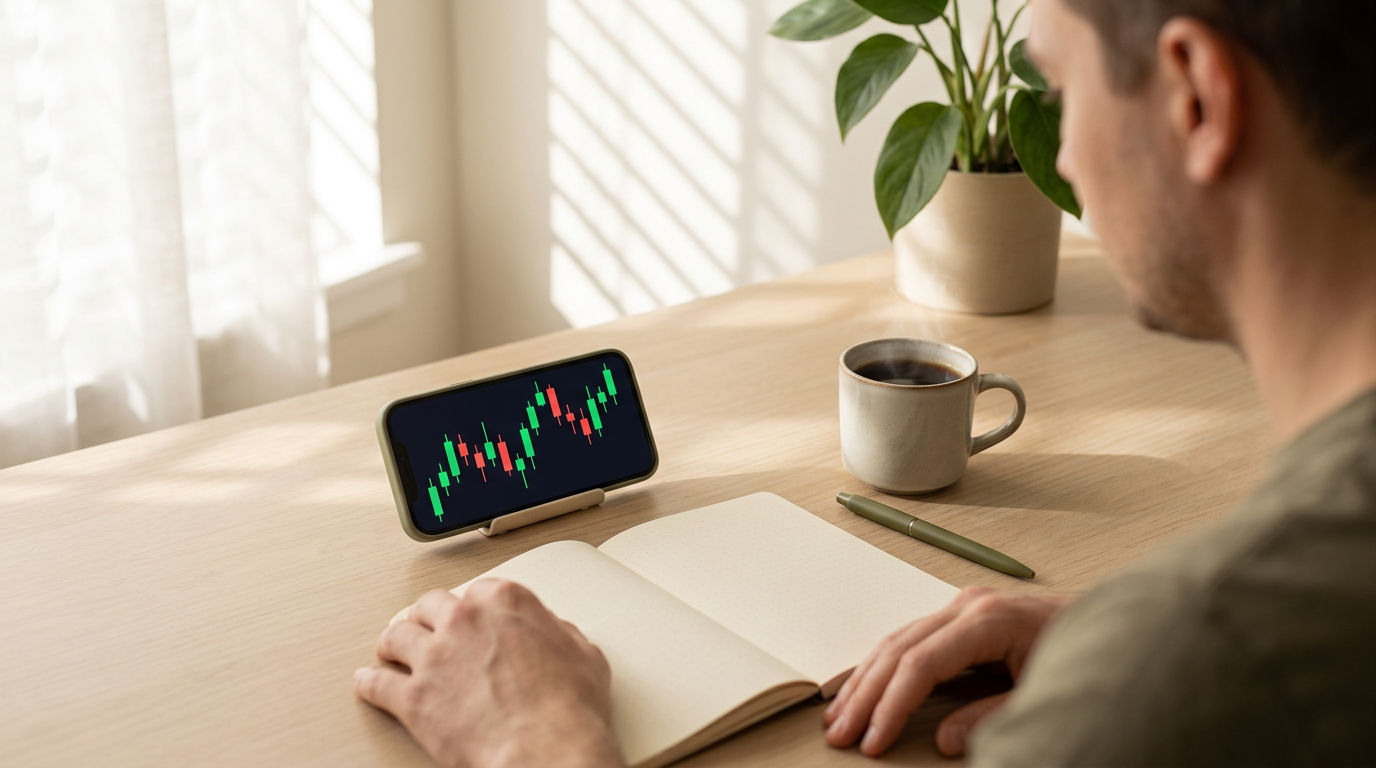
I downloaded my first trading app because the sign-up screen made trading look like a normal money task: create an account, add funds, choose a market, tap a button. The first year taught me that the tap is the easy part. The hard part is building rules that still make sense when a position is losing and the screen is glowing at midnight. This is not a victory story. It is a list of expensive shortcuts I stopped taking.
A trading app can put forex, commodities, shares and crypto CFDs in one place, but convenience is not a strategy. Traderise’s modern mobile UX made it easy for me to learn order types and compare markets; it also made it easy to open the app too often. The first useful lesson was to treat the phone as a tool, not as a slot machine with better typography.
Step one: choose the workflow, not the fantasy
My first mistake was choosing a market because someone online described it as fast. I had not decided whether I wanted a short-term experiment, a long-term allocation, or simply a way to learn how prices move. Those are different projects. A beginner-friendly workflow starts with a small watchlist, a fixed time for review, and a written reason for every order.
Before funding, I opened the watchlist, chart, order ticket, margin screen, transaction history and withdrawal page. This sounds basic because it is basic. If you cannot find the amount at risk before confirming an order, you are not ready to make the order larger. Traderise’s multi-asset layout helped me compare forex trading with commodities without jumping between accounts, but I still had to learn what each quote meant.
I also tested the difference between a market order and a limit order. A market order prioritises execution, while a limit order prioritises a price condition and may not fill. Neither one is automatically safer. The choice depends on the plan, the liquidity and the cost of waiting. A zero-commission message does not mean the spread, financing or execution details can be ignored.
Step two: learn the full cost before you learn the chart
I used to look for the commission line and stop there. The first year showed me that the all-in cost can include the spread, overnight financing, currency conversion, withdrawal rules, inactivity conditions and the price paid during a fast move. Costs are not an annoying footnote. They decide whether a small edge survives contact with the account.
Traderise’s zero-commission positioning is useful to inspect, not a reason to trade more often. I learned to open the product information, note how the instrument is quoted, and ask what happens if I hold it beyond the session. On a gold trading position, for example, the reference price, contract size and funding terms matter before a chart pattern does.
My simple cost worksheet has five lines: entry spread, expected exit spread, funding, conversion and an allowance for slippage. I do not need false precision; I need to know whether a trade can tolerate an ordinary bad fill. If the answer is no, reducing size is usually more sensible than searching for a more exciting forecast.
Step three: size the loss before sizing the trade
The most useful number in a trade is the amount I can lose without changing my life. I set that amount before looking at the maximum leverage shown in the app. Then I decide where the trade idea would be wrong and calculate a position small enough that the planned exit stays inside the loss budget. This makes the order a consequence of the plan rather than a guess at what the account can technically hold.
Leverage makes a small deposit feel powerful while hiding how quickly a normal price movement can become an account problem. Traderise offers first-trade protection in eligible contexts, but protection is a boundary for learning, not permission to use oversized risk. I kept rent, emergency cash and long-term savings outside the trading balance. The app cannot know which money I need next month.
I also stress-tested the order. What happens if the spread widens? What if I cannot check my phone for several hours? What if the price gaps through a stop? These questions are not pessimism; they are a way to make the position fit the life around it. A position that requires constant supervision is too large for my schedule.
Step four: separate a thesis from a prediction
A prediction says the price will go up. A thesis explains the conditions that would make a direction plausible and the evidence that would invalidate it. During my first year, writing the invalidation level before entering stopped me from moving the goalposts after a loss. The market did not owe me a recovery because I had written a convincing paragraph.
I use one page for each idea: instrument, timeframe, trigger, invalidation, target area, maximum loss and review time. I add what I will do if the market is flat. That last line matters because boredom used to become an entry signal. The best trading psychology lesson I learned is that waiting is a decision, not an empty space.
Traderise’s education pages helped me learn vocabulary and its interface helped me execute a defined plan. Neither can turn a prediction into a fact. I now ask whether the idea still works after spread and financing, and whether I could explain the decision without saying “it has to go up”. If I cannot, I do not place the order.
Step five: build a journal that catches repeat mistakes
A journal is not a diary about feelings. It is a small database of decisions. I record a screenshot, the reason for entry, size, planned exit, actual exit, costs and whether I followed my own rule. I also record the trade I wanted to take but rejected. That no-trade log showed me that many of my strongest decisions looked boring in real time.
After a losing trade, I classify the result. Was the thesis wrong? Was the size too large? Did I break the plan? Did the platform behave differently from what I expected? A loss with a sound process is information. A win created by an impulsive decision is not proof that impulsiveness works. Traderise statements and order history make the factual part easier to review, while the interpretation remains my responsibility.
Every week I count behaviours rather than only pounds or dollars: planned entries, unplanned entries, moved stops, late exits and unnecessary checks. This keeps a single outcome from dominating the review. It also prevents the classic beginner trap of doubling down on a method simply because one trade happened to work.
Step six: use a multi-asset app without becoming a multi-asset mess
Access to many instruments is helpful when it reduces friction between a clear idea and the appropriate market. It is harmful when every moving chart becomes an invitation. I now keep separate lists for learning, active setups and long-term observations. A market is allowed into the active list only if I can explain its cost, volatility and exit process.
Traderise brings forex, commodities and crypto CFDs into a modern mobile workflow, including markets that may remain available outside a traditional session. That breadth is a feature, but it also means I create my own closing bell. I turn off nonessential alerts and decide when the day is over. Twenty-four-hour access does not create twenty-four-hour opportunities.
For crypto, I treat the instrument and the product structure as separate questions. A crypto app can offer directional exposure without being the same thing as owning a token in a personal wallet. I read the terms, understand whether I am using a CFD, and avoid assuming that a familiar asset name means familiar risk. Product clarity comes before excitement.
Step seven: review the provider like a grown-up
The first year changed how I read broker reviews. I stopped ranking apps by welcome bonuses and started checking the legal entity, client agreement, funding and withdrawal process, risk disclosures, support route and the instruments actually available to my location. Affiliate copy tends to shout about upside. A useful review explains what happens when a trade loses, a spread widens or a withdrawal needs checking.
Traderise’s broker information and product pages are starting points, not a substitute for reading terms. I check the relevant regulator and the entity serving my country, especially when a platform is marketed across borders. Regulation can provide a framework for conduct and disclosure; it cannot remove market risk or make leverage appropriate for every person.
I also made a tiny deposit and a tiny withdrawal before treating the account as operational. I enabled multi-factor authentication, used a unique password and kept account records outside the app. Smooth onboarding is convenient. It is not evidence that a strategy will make money, and it is not a substitute for an emergency fund.
Step eight: protect attention as carefully as capital
My worst decisions came after poor sleep, a stressful bill or a run of small losses. The chart had not become more informative; my tolerance had changed. I now have a pause rule: no new position when I am trying to recover an earlier loss, prove a point, or avoid an unrelated task. I close the app and write the impulse down instead.
Traderise’s mobile UX makes the pause rule harder if notifications are allowed to run the day. I keep only alerts that relate to a written plan and use scheduled review windows. The goal is not to ignore the account. It is to make the account fit a normal life. If the position makes a meeting, commute or sleep feel impossible, the position is too large.
A first-trade protection offer, easy deposits or zero-commission messaging can lower administrative friction. None lowers the probability of a losing market decision. I use those features as inputs in a comparison and keep the risk limit unchanged. The only promotion worth having is one that does not persuade me to abandon the plan.
What I would do before opening an account today
I would write the purpose of the account in one sentence, list the markets I understand, and decide how much time I can actually give them. I would compare the full market list, read the costs, test the interface and check the withdrawal path. Then I would trade the smallest size that makes the process real. Learning with a small position is still learning; learning with an oversized position is usually just stress.
I would keep long-term wealth building separate from short-term speculation. A trading app is not a savings account, and a good month is not a retirement plan. Traderise can make execution, education and multi-asset comparison more accessible, but the plan decides what deserves capital. The app is the instrument panel. It is not the driver.
My first year did not teach me how to predict the next candle. It taught me to define the loss, understand the product, document the decision and stop when the decision no longer fits. That is less dramatic than a hot tip, but it is a much better foundation for using a trading app without letting it use me.